Running can leave your calves, arches, glutes, and hamstrings feeling tight long after a workout. The right massage ball provides a convenient way to apply focused pressure at home, before training, or during recovery.
We compared 10 massage balls for runners across firmness, shape, texture, portability, and intended use. This guide will help you choose a practical option for trigger-point work, foot relief, mobility, or everyday post-run maintenance.
Best 10 Massage Balls for Runners Picks for 2026
Best Simple Trigger-Point Pick

- Firm solid-rubber construction
- Two compact balls for targeted pressure
- Works at home, the gym, or on the go
Best For: Runners seeking simple, portable trigger-point relief
Best Foot-Recovery Set

- Four-piece foot and body set
- Supports hot or cold massage
- Includes varied textures and firmness
Best For: Runners prioritizing foot, heel, and arch recovery
Best Spine-Friendly Design

- Peanut shape works beside the spine
- Firm natural rubber construction
- Includes a carry bag and workout guide
Best For: Runners targeting back and stabilizing muscles
Best Runner-Friendly Foot Tool

- Textured spikes for foot and hand massage
- Designed for runners and recovery
- Portable, floor-friendly rubber design
Best For: Runners needing targeted foot and plantar-fascia massage
Best Lacrosse-Style Pick
Fitzelar Massage Lacrosse Ball

- Firm 2.5-inch ball for focused pressure
- Natural rubber balances firmness and comfort
- Compact design with included gift bag
Best For: Portable, targeted post-run muscle and fascia work
Best Intensity Variety
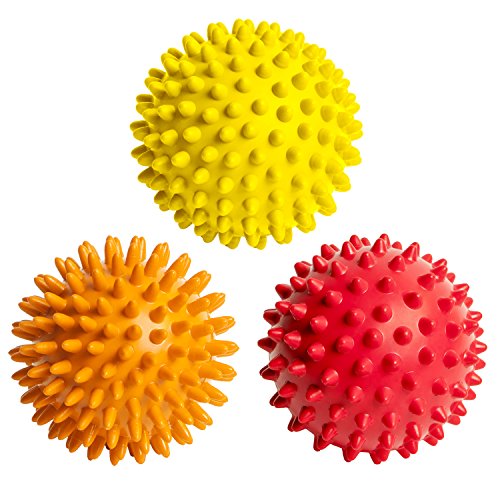
- Firm, medium, and extra-soft intensity options
- Spiky surface supports targeted stimulation
- Portable and easy-to-wash construction
Best For: Runners who want adjustable pressure for feet and recovery
Best for Deep Tissue Targeting

- Firm foam supports deep-tissue massage
- 3-inch size focuses pressure on tight spots
- Designed for legs, IT band, and back
Best For: Firm, targeted recovery after running or workouts
Most Versatile Kit

- Three-ball recovery system
- Covers feet, legs, back, and more
- Includes bag and 40-page guide
Best For: Runners wanting varied pressure options for full-body recovery
Best Compact Trigger-Point Option
Textured Deep Tissue Massage Ball

- Textured 2.8-inch pressure surface
- Firm EVA construction
- One-year replacement or refund warranty
Best For: Runners needing portable, focused relief for knots and feet
Best for Custom Pressure
4KOR Three-Ball Recovery System

- Three sizes for varied muscle groups
- Large ball targets lower-body areas
- Limited lifetime warranty
Best For: Runners wanting adjustable coverage for legs, glutes, and upper body
Best Simple Trigger-Point Pick – Firm Lacrosse Massage Balls
For runners who want straightforward massage balls for runners, this two-piece set uses firm, solid rubber balls for compression-based trigger-point work. Lean into the ball and use body weight to target tight or sore areas at home, the gym, or while traveling.
Best For: Runners seeking durable, portable balls for general muscle knots and tension.
Pros:
- Firm 100% solid rubber construction.
- Useful on the floor, a yoga mat, a chair, or in bed.
- Compact two-ball set for home, office, gym, or travel use.
Cons:
- The firm, smooth design may feel intense for sensitive users.
- It is not water resistant.
This is a practical minimalist option for runners who prefer simple, firm tools and adjustable pressure rather than textured surfaces or hot-and-cold features.
Best Foot-Recovery Set – Vive Hot-and-Cold Massage Kit
This four-piece Vive kit is a versatile choice among massage balls for runners, especially if foot recovery is a priority. It combines a foot roller, two studded balls with different firmness levels, and a smooth ball, with options for warming or freezing the massage tools.
Best For: Runners focused on plantar fascia, heel, arch, and broader post-workout recovery.
Pros:
- Includes four tools for varied massage approaches.
- Massage balls can be warmed in hot water or frozen overnight.
- Portable, latex-free, and designed for foot and full-body trigger-point work.
- Backed by a 60-day guarantee.
Cons:
- The multi-piece set takes more storage space than a single ball.
- The tools are not water resistant.
Choose this set if you want more flexibility than a standalone ball, particularly for alternating textured, smooth, hot, and cold foot-massage routines.
Best Spine-Friendly Design – 5BILLION Peanut Massage Ball
The peanut shape gives this option a different feel from standard massage balls for runners. Its central separation is designed to work the muscles beside the spine while avoiding direct pressure on the vertebrae, and the natural rubber is firmer than a tennis ball.
Best For: Runners who want targeted work around the back, neck, shoulders, legs, or feet.
Pros:
- Peanut design targets stabilizing muscles alongside the spine.
- Firm natural rubber construction without hard plastic knobs.
- Includes a carry bag for gym, travel, or post-workout use.
- Comes with usage instructions and a workout guide.
Cons:
- Its 5-inch length is less compact than a single spherical ball.
- The firm design may not suit users seeking gentle massage.
- It is not water resistant.
This is a strong fit for runners who want a portable self-massage tool with a specialized shape for controlled rolling around, rather than directly on, the spine.
Best Runner-Friendly Foot Tool – Due North Foot Rubz
The Due North Foot Rubz is a compact option for massage balls for runners who mainly need foot and hand relief. Its dense rubber spikes provide textured pressure while the flattened spike design is intended to avoid marking floors.
Best For: Runners seeking a small travel tool for feet, hands, plantar fascia, and everyday tension.
Pros:
- Designed specifically for runners, athletes, and recovery.
- Flat rubber spikes provide textured massage without damaging floors.
- Small and travel-friendly for home, office, gym, or trips.
- Made in the USA.
Cons:
- It is primarily intended for feet and hands rather than whole-body use.
- The spiky texture may feel too intense for some users.
- It is not water resistant.
For runners who want a dedicated foot-massage ball instead of a general-purpose trigger-point tool, the Rubz offers portability, textured pressure, and a floor-friendly design.
Best Lacrosse-Style Pick – Fitzelar Massage Lacrosse Ball
For runners who want a compact tool for post-run tightness, this lacrosse-style ball provides focused pressure for the feet, legs, back, and other areas. Its 2.5-inch natural-rubber construction is designed to feel firmer than a soft tennis ball while remaining more forgiving than a hard golf ball.
Best For: Runners seeking a portable, single-point massage ball for myofascial release and muscle-fatigue relief.
Pros:
- Firm, 45-degree hardness targets fascia and muscle knots.
- Natural rubber offers a balance of firmness and softness.
- Lightweight travel size includes a gift bag for portability.
- Can be used against a wall or under the foot.
Cons:
- Its focused pressure may feel intense on sensitive areas.
- It is a single ball rather than a multi-intensity set.
- Not water resistant.
The Fitzelar is a straightforward choice when you prefer firm, targeted pressure and want one massage ball that can fit easily in a running or travel bag.
Best Intensity Variety – Octorox Spiky Massage Ball
Runners who want to adjust pressure may prefer this 3-inch spiky massage ball. Its firm, medium, and extra-soft options are designed for different comfort levels, making it useful for feet, calves, back, hands, and other areas after exercise.
Best For: Runners who want customizable pressure for foot relief, recovery sessions, and general mobility work.
Pros:
- Three intensity levels support both deep stimulation and gentler massage.
- Spikes target muscle tissue, fascia, nerves, and trigger points.
- Lightweight, tennis-ball-sized design is easy to carry.
- Non-toxic material is washable, odorless, and residue-free.
Cons:
- Spikes may feel too stimulating on sensitive areas.
- The 3-inch size may be less precise than a smaller ball for tiny trigger points.
- Not water resistant.
The Octorox stands out for flexibility: runners can choose a softer feel for tender feet or a firmer option for more pronounced post-exercise tension.
Best for Deep Tissue Targeting – Pro-Tec Orb Extreme Mini
The Pro-Tec Orb Extreme Mini is a 3-inch massage ball built for runners who want focused work on areas such as the hamstrings, quadriceps, calves, IT band, and back. Its firm foam construction and smaller diameter are intended to support deeper, single-point releases.
Best For: Runners looking for a firm, multi-directional ball to target larger leg muscles and tight spots after activity.
Pros:
- Firm foam construction provides a deep-tissue massage feel.
- 3-inch diameter helps focus pressure on selected muscle areas.
- Supports work on calves, quadriceps, hamstrings, IT band, and back.
- Multi-directional design can help address muscle fatigue and tightness.
Cons:
- Firm pressure may not suit runners seeking a softer massage.
- It is sold as one ball rather than a set of sizes.
- Not water resistant.
The Orb Extreme Mini is a strong option for targeted recovery when your priority is firm pressure and access to common running-related muscle groups.
Most Versatile Kit – Plyopic Massage Ball Set
For runners who want more than one pressure option, this massage ball set combines a rubber lacrosse ball, spiky ball, and foam roller ball. It is designed for post-run muscle recovery, trigger-point work, mobility, and tired feet, with a carrying bag and guide for use at home, work, or the gym.
Best For: Runners seeking a portable, full-body massage-ball kit with dedicated options for feet, legs, back, and other tight areas.
Pros:
- Three-ball system supports both broad and targeted muscle work.
- Suitable for back, neck, shoulders, glutes, legs, knees, hands, and feet.
- Includes a carrying bag and 40-page user guide.
- Designed for mobility work, myofascial release, and post-workout recovery.
Cons:
- Its three-piece format may be more equipment than runners who want a single ball need.
- The included balls provide different textures and firmnesses, so users may need to test which option suits each area.
With multiple shapes and a travel-friendly setup, this is a flexible choice for runners building a broader recovery routine rather than looking for one compact trigger-point ball.
Best Compact Trigger-Point Option – Textured Deep Tissue Massage Ball
This 2.8-inch textured massage ball is a straightforward option for runners who prefer focused pressure on knots, feet, legs, and other small areas. Its high-density EVA construction is intended to stay firm under pressure, while its compact size fits easily in a gym bag, desk drawer, or suitcase.
Best For: Runners who want one portable, textured ball for targeted post-run recovery and plantar-fascia-focused foot work.
Pros:
- Textured surface concentrates pressure on trigger points and smaller muscle areas.
- High-density construction is designed to maintain its shape under pressure.
- Compact, lightweight, quiet, and suitable for use against a wall or table.
- Includes a one-year warranty covering cracking or deformation.
Cons:
- A single 2.8-inch ball offers less versatility than a multi-ball set.
- The textured design may feel more intense on sensitive areas than a smooth ball.
This is a practical pick when portability and targeted pressure matter most. The documented material testing and warranty add reassurance for regular recovery use.
Best for Custom Pressure – 4KOR Three-Ball Recovery System
Runners who want to adjust coverage and pressure can use this three-ball system across different parts of the body. The larger 4.75-inch ball is aimed at the psoas, quadriceps, IT band, and glutes; the 3.2-inch ball suits upper-body areas; and the lacrosse ball provides more precise trigger-point work.
Best For: Runners who want distinct ball sizes for lower-body recovery, upper-body tension, and precise hamstring or glute work.
Pros:
- Three sizes support different muscle groups and pressure needs.
- Larger ball targets quads, IT band, glutes, and psoas.
- Smaller ball and lacrosse ball support shoulder, trap, neck, hamstring, and glute-focused work.
- Includes guided application points and carries a limited lifetime warranty.
Cons:
- The 1.8-pound set is less lightweight than a single massage ball.
- It is not water resistant, so it requires care around moisture.
- Its broader size range may take more space in a running or gym bag.
The 4KOR set makes sense for runners who want a more structured, customizable recovery routine. Its body-specific sizing is especially useful when lower-body treatment is the priority.
How We Picked the Best Massage Balls for Runners
We focused on products designed for self-massage, myofascial release, trigger-point work, mobility, and foot relief. The roundup includes compact single balls, two-ball sets, peanut-shaped tools, multi-piece kits, and textured rollers so runners can compare different approaches to recovery.
Our comparisons emphasize construction, firmness, surface texture, shape, size variety, portability, and the body areas each design can realistically reach. A massage ball should feel controlled and stable rather than simply being as hard or aggressive as possible.
Quick Comparison
| Type | Best For | Typical Advantage |
|---|---|---|
| Firm lacrosse-style ball | Glutes, calves, back, and general trigger points | Strong, focused pressure |
| Peanut ball | Along the spine and larger muscle groups | More controlled two-point contact |
| Spiky ball or roller | Feet, hands, and surface-level stimulation | Textured feedback and easy rolling |
| Multi-ball set | Runners who want different pressure levels | More versatility in one purchase |
| Compact orb | Travel and targeted muscle work | Portable, precise positioning |
Key Buying Factors for Massage Balls for Runners
Firmness
Firm balls are useful for dense muscles and stubborn knots, but they can feel too intense on tender areas. Medium or softer options are often better for beginners, sensitive feet, or frequent use after long runs.
Shape and Size
A round ball offers versatile trigger-point work. A peanut design can help apply pressure beside the spine without pressing directly on it. Smaller balls are more precise, while larger balls spread pressure across calves, glutes, or hamstrings.
Surface Texture
Smooth surfaces generally provide predictable pressure and glide well against a wall or floor. Spikes add sensory stimulation and can work well under the feet, though they may be uncomfortable for highly sensitive users.
Portability and Maintenance
For gym bags and travel, choose a compact ball or small set. Nonporous materials are easier to wipe clean, and a stable shape is less likely to roll away during floor-based exercises.
Safe Use
Start with light pressure and short sessions, especially after an injury or unusually hard workout. Avoid rolling directly over bones, joints, open wounds, varicose veins, or areas with sharp pain. Massage tools should support recovery, not replace medical evaluation.
Who Should Buy Which Massage Balls for Runners?
Choose a firm lacrosse-style ball if you want one inexpensive, versatile tool for calves, glutes, hamstrings, shoulders, and general trigger points.
Choose a peanut ball if you want more stable two-sided contact for mobility work or areas alongside the spine. Use it carefully and avoid direct pressure on the spine itself.
Choose a spiky ball or foot roller if your main concern is tired arches, plantar-foot tightness, or hands and forearms. These designs are especially convenient for seated use.
Choose a multi-piece set if you are new to self-massage, share tools with a training partner, or want to experiment with different firmness levels and textures.
Choose a compact orb if portability and precise placement matter most. It is a practical choice for runners who want recovery equipment that fits easily in a desk drawer, suitcase, or running bag.