The best lightweight stunt scooters make tricks, jumps, and skatepark sessions easier to control without sacrificing the strength riders need for repeated landings. This roundup compares 10 options for children, teens, and adults across beginner and intermediate skill levels.
Use the buying guide below to match scooter weight, bar height, deck dimensions, wheel setup, and construction with the rider’s size and goals.
Best 10 Lightweight Stunt Scooters Picks for 2026
Best Overall
Mongoose Rise Freestyle Stunt Scooter

- 220-pound rider capacity
- Alloy deck and welded steel T-bar
- 100mm wheels with ABEC-7 bearings
Best For: Versatile recreational riding and trick practice
Best for Growing Riders

- Two listed height options
- 7.3-pound build with 220-pound capacity
- 100mm wheels and ABEC-9 bearings
Best For: Young riders practicing street and skate-park skills
Lightest Performance Pick

- Only 3.3 kg
- 110mm wheels with ABEC-9 bearings
- Heat-treated aluminum deck
Best For: Beginners and intermediates prioritizing maneuverability
Best for Kids 8–12

- Built for young freestyle riders
- 110mm wheels with ABEC-7 bearings
- Three-year manufacturer warranty
Best For: Kids learning skate-park and street tricks
Best Lightweight Pick
FREEDARE JB 1 Pro Stunt Scooter

- Light 3.2 kg build for easier trick practice
- 810 mm bar and 100 mm solid-core wheels
- 220-pound maximum load
Best For: Beginners and entry-level freestyle riders
Best Beginner Brand Option

- Beginner-focused design for ages 6–12
- 3.58 kg aluminum construction
- Full manufacturer warranty and ten finishes
Best For: Young beginners practicing pavement and skatepark riding
Best for Progression
FREEDARE JB283A-O Pro Stunt Scooter

- 110 mm high-rebound wheels with ABEC-5 bearings
- Reinforced steel bar and welded headtube
- Wide 110 mm aluminum deck and three-bolt clamp
Best For: Teens and intermediate riders progressing in park and street tricks
Lightweight Starter Pick

- Very light 2.9 kg design
- ABEC 7 wheels and aluminium deck
- Quiet rear brake and 4-bolt clamp
Best For: Young beginners learning their first scooter tricks
High-Capacity Freestyle Pick
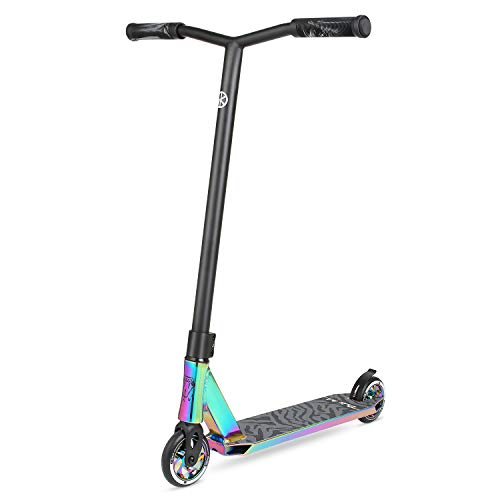
- 220-pound stated weight capacity
- ABEC-9 bearings and 110 mm alloy wheels
- Aluminium deck with one-piece fork
Best For: Progressing riders, teens, and adults
Entry-Level Progression Pick

- Built for beginners learning basic tricks
- 6061 aluminium deck and Chromoly bar
- Triple clamp and reinforced plates
Best For: Young riders starting freestyle scooter skills
Best Overall – Mongoose Rise Freestyle Stunt Scooter
The Mongoose Rise is a practical pick among lightweight stunt scooters for riders ages 8 and up. Its alloy deck, welded steel T-bar, 100mm wheels, and 220-pound capacity make it suitable for recreational riding, tricks, and general transportation.
Best For: Youth and adult riders who want a sturdy, versatile stunt scooter with a generous weight limit.
Pros:
- Lightweight alloy deck with an extended standing area
- Heavy-duty frame supports riders up to 220 pounds
- ABEC-7 bearings and high-impact alloy wheels support smooth rolling
- Bike-style grips and a rear steel brake add comfort and control
Cons:
- At 5.21 kg, it is not the lightest option in this roundup
- Its 100mm wheels are smaller than those on some competing models
- The handlebar is not described as height adjustable
The Rise balances durability, capacity, and everyday usability. It is a strong all-around choice when a rider needs one scooter for both casual use and stunt practice.
Best for Growing Riders – Dadywheels Pro Stunt Scooter
This Dadywheels model is a flexible option among lightweight stunt scooters, with two listed height choices and a 220-pound capacity. The 31.5-inch version combines a lightweight aluminum deck, steel T-bar, 100mm polyurethane wheels, and ABEC-9 bearings for practice and everyday riding.
Best For: Younger riders and teens who need a comfortable setup for street riding, skate parks, and learning new skills.
Pros:
- Available in two scooter heights for different rider needs
- Lightweight 7.3-pound construction supports up to 220 pounds
- ABEC-9 bearings and polyurethane wheels support responsive rolling
- Textured grip tape, ergonomic grips, and a rear foot brake aid control
Cons:
- The supplied specifications list the 31.5-inch version, so buyers should confirm the selected height
- Its steel components may feel less light than a more performance-focused build
- Recommended rider height is limited to approximately 3’6″–5’1″ for the listed version
With rider-oriented sizing and a supportive deck, this scooter is well suited to progression. Confirm the height option before ordering to match the rider’s stature.
Lightest Performance Pick – LIMIT LMT69 Pro Trick Scooter
At 3.3 kg, the LIMIT LMT69 stands out among lightweight stunt scooters for beginners and intermediate riders. Its heat-treated aluminum deck, CrMo4130 T-bar, 110mm wheels, and ABEC-9 bearings are designed for riders ages 8 and up weighing less than 200 pounds.
Best For: Riders who prioritize low weight and skate-park maneuverability while progressing from beginner to intermediate tricks.
Pros:
- Very light 3.3 kg overall weight
- Heat-treated aluminum deck and high-strength CrMo4130 T-bar
- 110mm wheels with ABEC-9 bearings support smooth rolling
- Mostly assembled and backed by a six-month limited warranty
Cons:
- Maximum rider weight is lower than several alternatives at 200 pounds
- The six-month warranty is shorter than some competing coverage
- The supplied details describe it as foldable, but stunt scooters are generally less convenient to carry when folded
The LMT69 is the clearest choice here for riders who want a lightweight, responsive feel. Its lower weight limit and shorter warranty are the main trade-offs for that portability.
Best for Kids 8–12 – Madd Gear MG3 Stunt Scooter
The Madd Gear MG3 is one of the more feature-focused lightweight stunt scooters for kids ages 8–12. It pairs an extruded aluminum deck with a steel handlebar, double clamp, 110mm polyurethane wheels, and ABEC-7 bearings for skate-park and street progression.
Best For: Kids ages 8–12 learning freestyle tricks and wanting a scooter with a 220-pound capacity and long warranty.
Pros:
- Designed specifically for young freestyle riders
- 110mm polyurethane wheels and ABEC-7 bearings support smooth, quiet rolling
- Textured grip tape, responsive brake, and 150mm grips aid control
- Includes easy assembly and a three-year manufacturer warranty
Cons:
- At 10 pounds, it is heavier than the lightest scooter in this group
- The listed handlebar height is fixed at 32 inches
- The supplied details do not specify adjustable handlebar height
The MG3 emphasizes kid-friendly control and durability rather than minimum weight. Its three-year warranty and 220-pound capacity add reassurance for regular practice and progression.
Best Lightweight Pick – FREEDARE JB 1 Pro Stunt Scooter
For shoppers comparing lightweight stunt scooters, the FREEDARE JB 1 is a practical beginner-friendly option with a 3.2 kg build, a fixed 810 mm bar, and a 220-pound maximum load. Its compact 100 mm wheels and welded aluminum deck are suited to early park and street practice.
Best For: Beginners and entry-level freestyle riders who want a light scooter for learning tricks.
Pros:
- Light 3.2 kg construction can make tricks easier to practice.
- One-piece welded fork-and-deck connection is rated for impact capacity up to 1,800 pounds.
- Solid-core 100 mm wheels and smooth bearings support park and street riding.
- Supports riders up to 220 pounds.
Cons:
- The 810 mm overall height may not suit every rider, so measuring hip-to-navel height is recommended.
- Lightweight decks may not last as long as heavier decks.
- Requires regular bolt tightening and care away from water, sand, and humidity.
With its low weight, adjustable-to-rider sizing guidance, and beginner-oriented setup, the JB 1 is a sensible starting point for learning freestyle fundamentals without choosing a heavy scooter.
Best Beginner Brand Option – Envy Scooters ONE S3
The Envy ONE S3 is a beginner-focused choice among lightweight stunt scooters, weighing 3.58 kg and using quality components drawn from Envy’s higher-level models. Its 23-inch handlebar and 110 mm wheels make it appropriate for young riders practicing on pavement or at the skatepark.
Best For: Children ages 6–12 beginning freestyle riding and skatepark practice.
Pros:
- Designed specifically as an entry-level freestyle scooter.
- Lightweight aluminum construction weighs 3.58 kg.
- Uses quality components associated with Envy’s upgraded scooter models.
- Available in ten colorful powder-coated finishes and includes a full manufacturer warranty.
Cons:
- Its recommended age range and 23-inch handlebar may be limiting as a child grows.
- At 3.58 kg, it is slightly heavier than the FREEDARE JB 1 listed here.
- It is intended for beginners rather than advanced riders.
The ONE S3 combines a manageable weight with a clearly beginner-oriented design and brand-backed warranty. It is a strong fit when appearance, straightforward entry-level setup, and skatepark usability matter most.
Best for Progression – FREEDARE JB283A-O Pro Stunt Scooter
Riders comparing lightweight stunt scooters for progression may prefer the FREEDARE JB283A-O. It is built for intermediate riders and teens, with a reinforced steel bar, 110 mm high-rebound PU wheels, a wide aluminum deck, and a three-bolt clamp for more demanding park and street practice.
Best For: Teens and intermediate beginners ready for stronger components and more stable landings.
Pros:
- 110 mm, 88A high-rebound PU wheels with ABEC-5 bearings offer speed and stability.
- 31.8 mm steel handlebar and 135 mm TPR grips provide strength and control.
- Wide 110 mm aluminum deck and welded headtube and neck target high-impact tricks.
- Three-bolt aluminum clamp and steel brake support secure handling and stopping.
Cons:
- At 4.11 kg, it is heavier than the other two scooters in this roundup.
- The stronger, larger setup may be less manageable for smaller or very young riders.
- The supplied details list a maximum age recommendation of 12 despite describing the scooter for teens and intermediate riders.
This model trades some portability for reinforced components, larger wheels, and a broader deck. It makes the most sense for a rider moving beyond basic practice who values control and durability-oriented construction.
Lightweight Starter Pick – BOLDCUBE Stunt Scooter
If you’re comparing lightweight stunt scooters for a young beginner, the BOLDCUBE stands out at 2.9 kg (6.4 lb). Its aluminium deck, ABEC 7 wheels, crystallised grip surface, and 4-bolt clamp are designed to make early tricks easier to control while keeping the setup durable.
Best For: Beginner riders aged roughly 8–12 who want a particularly light scooter for learning basic stunts.
Pros:
- Very light 2.9 kg construction for easier handling.
- Aluminium deck and 4-bolt clamp support freestyle use.
- ABEC 7 wheels and a scratch-resistant crystallised grip surface.
- Quiet, controlled spring-free rear brake.
Cons:
- It is positioned as an entry-level model, so advanced riders may want more specialised components.
- The listed maximum age recommendation is 12.
The BOLDCUBE is a sensible choice when low weight is the priority. It combines beginner-friendly handling with features suited to first spins, jumps, and other basic tricks.
High-Capacity Freestyle Pick – VOKUL K1 Pro Scooter
The VOKUL K1 is one of the more substantial lightweight stunt scooters for riders who want room to progress. It pairs a T-6061 aluminium deck with a one-piece fork, 110 mm alloy wheels, ABEC-9 bearings, and a claimed 220-pound weight capacity.
Best For: Beginner to intermediate riders aged 8 and up, including teens and adults who need a higher-capacity freestyle scooter.
Pros:
- Supports up to 220 pounds according to the supplied specifications.
- ABEC-9 bearings are intended to provide a smooth glide.
- T-6061 aluminium deck and one-piece fork suit freestyle riding.
- Soft 145 mm grips and a noise-free rear brake improve ride comfort.
Cons:
- At 9 pounds, it is heavier than the BOLDCUBE.
- The listed maximum age recommendation is 12 despite the stated adult capacity.
- Assembly still requires tightening the three-bolt clamp.
The K1 makes more sense than an ultra-light beginner model when durability, capacity, and progression matter more than carrying weight. Its higher-precision bearings and robust components are useful for regular park sessions.
Entry-Level Progression Pick – VOKUL Complete Pro Scooter
For families seeking lightweight stunt scooters for learning basic tricks, this complete VOKUL model offers a sturdy entry point. It uses a 6061 aircraft-aluminium deck, a 4130 Chromoly batwing bar, reinforced forged plates, and a triple clamp for added stability.
Best For: Beginning riders around ages 7–14 who are learning barspins, tail taps, and tailwhips.
Pros:
- Designed specifically for beginners with little or no experience.
- 6061 aluminium deck and 4130 Chromoly bar balance low weight with strength.
- Reinforced plates and triple clamp support stability during practice.
- Claimed 220-pound capacity accommodates a broad range of riders.
Cons:
- At 8 pounds, it is not the lightest option in this roundup.
- The fixed handlebar offers less fitting flexibility than an adjustable design.
- It is intended for entry-level progression rather than advanced custom setups.
This VOKUL is a practical first freestyle scooter for riders building confidence. Its reinforced construction should provide a stable platform for progressing from basic recreational riding to beginner skatepark tricks.
How We Picked These Lightweight Stunt Scooters
We focused on scooters designed for freestyle riding rather than everyday commuting. The selection considers aluminum deck construction, reinforced frames, fixed handlebars, compression-ready designs, wheel size, bearing quality, rider-age guidance, and the balance between manageable weight and durability. We also included choices for younger beginners, progressing riders, teens, and adults.
Product specifications and stated age ranges can vary by version, so confirm the current measurements, maximum rider weight, and included components before buying.
Quick Comparison
- Best for broad age coverage: Mongoose Rise, with a stated capacity suitable for many older children, teens, and adults.
- Best for height flexibility: The two-height pro scooter option, which offers a choice between approximately 31.5-inch and 36.6-inch configurations.
- Best for younger beginners: Envy ONE S3 and BOLDCUBE models, both aimed at younger riders developing basic freestyle skills.
- Best for progressing riders: VOKUL K1, FREEDARE Pro, and LMT69 options, which are positioned for beginner-to-intermediate trick riding.
- Best wheel-focused option: Madd Gear’s model, featuring 110mm wheels and ABEC-7 bearings.
Key Buying Factors for Lightweight Stunt Scooters
Weight and Rider Size
A lighter scooter is generally easier to lift, spin, and redirect during tailwhips or jumps. However, the lightest option is not automatically the best choice. Larger or more aggressive riders may need a stronger deck and frame, even if that adds a little weight.
Handlebar Height and Width
Bars should provide comfortable control without forcing the rider to hunch excessively. Check the manufacturer’s dimensions against the rider’s height and riding style. Adjustable-looking age labels are not a substitute for checking actual measurements.
Deck Size and Construction
A shorter, narrower deck can feel nimble for tricks, while a longer or wider deck offers more foot room and stability. Aluminum decks are common because they reduce weight, but weld quality, fork strength, and overall construction matter just as much.
Wheels, Bearings, and Compression
Common 110mm wheels offer a useful balance of speed and maneuverability. ABEC ratings can help describe bearing tolerances, but they do not alone determine ride quality. Also check whether the scooter uses a reliable compression system and whether replacement wheels, grips, and brake parts are readily available.
Who Should Buy Which Lightweight Stunt Scooters?
Choose a compact youth model for a smaller child who is learning balance, braking, and basic hops. Riders ages 8 to 12 who are beginning skatepark practice should prioritize a manageable deck and bar height over premium-looking graphics. Teens and adults should verify maximum weight capacity and dimensions first, then select a sturdier model that can handle repeated landings. Intermediate riders planning more demanding tricks should favor reinforced construction, dependable compression, and replaceable components. For occasional recreational use, a complete scooter with sensible specifications is usually better value than paying for advanced parts the rider may not yet use.