The best bike trainers with Zwift compatibility make indoor cycling more engaging by connecting your bike to structured workouts, virtual routes, racing, and performance data. The right model depends on your budget, bike setup, desired realism, and tolerance for noise or installation.
This roundup compares smart direct-drive trainers, wheel-on options, and traditional trainers with smart add-ons so you can choose a dependable setup for winter training, daily fitness, or immersive virtual rides.
Best 10 Bike Trainers with Zwift Compatibility Picks for 2026
Top Pick

- Includes 3rd-generation Zwift Cog and Click
- Integrated Wi-Fi for pairing and updates
- Smooth electronic resistance with road-like feel
Best For: Easy, Zwift-focused indoor training
Premium Choice
Garmin TacX NEO 2T Smart Trainer

- ANT+ and Bluetooth connectivity
- Up to 2,200 watts of training capacity
- Foldable design with multiple axle adapters
Best For: High-power training with broad device support
Best Value
COOSPO T10 Smart Direct-Drive Trainer

- 2,200W maximum resistance with 15% grade simulation
- ERG mode and ±2% power accuracy
- Supports Zwift, ANT+, Bluetooth, and multiple apps
Best For: Affordable, versatile smart indoor training
Best Connectivity
- 2.4 GHz Wi-Fi for stable ride-data transfer
- Over 2,200W resistance with ±1% accuracy
- Automatic calibration and AXIS feet
Best For: Dedicated setups prioritizing connectivity and precision
Premium Smart Direct-Drive Pick
- 2500W output with up to 25% simulated gradients
- ±1% stated accuracy with no calibration required
- Bluetooth and ANT+ connectivity for Zwift and other setups
Best For: High-power virtual riding and structured indoor training
Budget Wheel-On Choice
- Fits 26–29-inch and 700C wheels
- Six manually adjustable resistance levels
- Folds for storage and includes a riser block
Best For: Simple, portable indoor exercise without smart resistance
Feature-Rich Smart Trainer
CYCPLUS R200 Smart Bike Trainer

- BLE and ANT+ support for Zwift and MyWhoosh
- 2200W peak power with up to 19% gradient simulation
- Virtual shifting requires a separately sold BC2 Shifter
Best For: Connected training with strong app support and terrain simulation
Power Pick
ThinkRider X2Max Smart Trainer

- ANT+ and Bluetooth connectivity for Zwift
- Up to 2,000W and 18% simulated slope
- Stable frame with approximately 58dB noise at 30km/h
Best For: High-power virtual training and realistic gradient simulation
Easy Smart Setup

- Wheel-on installation keeps the rear wheel in place
- Zwift certified with ANT+ FE-C and Bluetooth
- Electromagnetic resistance with ±5% accuracy
Best For: Convenient app-connected training for road and mountain bikes
Budget-Friendly Classic
- Progressive fluid resistance mimics outdoor riding
- Foldable wheel-on design for simple storage
- Works with Zwift when paired with a separate sensor
Best For: Straightforward indoor training with optional virtual-platform use
Top Pick – Wahoo KICKR CORE 2 Zwift Cog
The Wahoo KICKR CORE 2 is a strong choice among bike trainers with zwift compatibility, especially if you want a streamlined setup built around Zwift. It combines electronic resistance, integrated Wi-Fi, and a road-like ride feel for structured indoor training.
Best For: Riders seeking an easy-to-connect Zwift-focused direct-drive trainer.
Pros:
- Includes the 3rd-generation Zwift Cog and Click for a simplified Zwift setup.
- Integrated Wi-Fi supports faster pairing and automatic updates on an active network.
- Provides smooth, road-like resistance for hard efforts and structured workouts.
Cons:
- The included setup is especially Zwift-oriented, so other drivetrain configurations may require additional compatibility checks.
- Its 13.6 kg weight may make moving and storing it less convenient.
The KICKR CORE 2 stands out for combining practical connectivity upgrades with Wahoo’s established ride feel. Its included Zwift accessories make it particularly appealing to riders who want to get into virtual cycling with less setup friction.
Premium Choice – Garmin TacX NEO 2T Smart Trainer
The Garmin TacX NEO 2T is a premium direct-drive option for shoppers comparing bike trainers with zwift compatibility and broad device support. Its magnetic resistance system connects through ANT+ or Bluetooth and works with iOS, Android, macOS, and Windows.
Best For: Experienced indoor cyclists who want broad wireless compatibility and a high-power training platform.
Pros:
- Supports ANT+ and Bluetooth connections across major operating systems.
- Rated for up to 2,200 watts, providing substantial capacity for demanding sessions.
- Includes a front wheel block, multiple axle adapters, and one month of Tacx Premium software.
- Foldable design can simplify storage between rides.
Cons:
- At 47.4 pounds, it is relatively heavy to reposition.
- The supplied notes do not identify Zwift-specific accessories or a cassette.
The NEO 2T is a feature-rich choice when connectivity and training capacity matter more than portability. Its foldable frame and extensive adapter selection add flexibility, while the substantial weight supports a stable indoor setup.
Best Value – COOSPO T10 Smart Direct-Drive Trainer
The COOSPO T10 offers a practical feature set for riders shopping for bike trainers with zwift compatibility at a lower-specification alternative to premium models. Its belt-driven direct-drive design supports Zwift and other platforms, with ERG mode, 15% grade simulation, and Bluetooth or ANT+ connectivity.
Best For: Budget-conscious riders who want smart resistance and broad app compatibility.
Pros:
- Provides up to 2,200 watts of resistance and 15% simulated grades.
- Supports automatic ERG mode for target-power workouts.
- Works with Zwift, Rouvy, TrainerRoad, Wahoo SYSTM, MyWhoosh, and other supported platforms.
- Belt-driven construction is designed for smooth, quieter operation and reduced maintenance.
Cons:
- A cassette is not included.
- SRAM XDR 12-speed setups require a separately sold freehub body, and Micro Spline is not directly compatible.
- Its stated power accuracy is ±2%, less precise than some premium alternatives.
The T10 delivers the core smart-trainer features many indoor riders need without relying on a single platform. Check your bike’s axle, cassette, and freehub requirements before buying, since drivetrain compatibility is a key part of the setup.
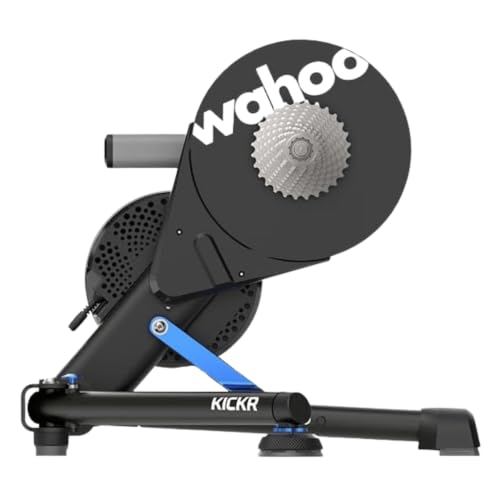
Best Connectivity – Wahoo KICKR V6 Smart Trainer
The Wahoo KICKR V6 is a capable option among bike trainers with zwift compatibility for riders who prioritize a stable connection and refined ride feel. Its 2.4 GHz Wi-Fi connection works alongside automatic calibration, electromagnetic resistance, and a high-inertia flywheel.
Best For: Serious riders who want dependable connectivity and precise, high-power resistance.
Pros:
- Wi-Fi transfers ride data to compatible computers, tablets, or smartphones.
- Offers more than 2,200 watts of resistance with stated ±1% accuracy.
- Automatic calibration is designed to maintain accurate power readings.
- KICKR AXIS feet are intended to add outdoor-like side-to-side movement.
Cons:
- Its listed 22 kg weight makes it less convenient to move.
- The supplied notes do not mention a Zwift Cog or Click being included.
- Its listed dimensions are unusually large, so verify available storage space.
The KICKR V6 focuses on the details that matter during demanding virtual rides: reliable data transmission, precise resistance, and a more natural-feeling platform. It is a strong fit for riders building a dedicated indoor training setup.
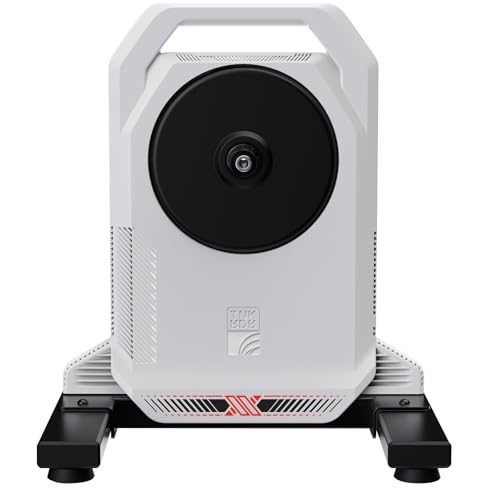
Premium Smart Direct-Drive Pick – ThinkRider XXPRO
For riders comparing bike trainers with zwift compatibility, the ThinkRider XXPRO stands out as a powerful direct-drive option with Bluetooth and ANT+ connectivity. Its motor-driven resistance, self-power capability, and terrain simulation make it suited to structured indoor training and virtual riding.
Best For: Riders wanting high power, realistic gradient simulation, and flexible Zwift connectivity.
Pros:
- 2500W maximum power and simulated gradients up to 25%.
- Direct motor drive with stated ±1% data accuracy and no calibration required.
- Supports Bluetooth, ANT+, bike GPS, PC, and Zwift connectivity.
- Can generate its own electricity or use the included power adapter.
Cons:
- Its 242-pound load capacity is lower than the magnetic trainer listed here.
- The direct-drive design is likely a more substantial investment than a basic wheel-on trainer.
- Compatibility details identify road bikes and a 26-inch wheel size.
The XXPRO is the strongest performance-focused choice in this group. Choose it when accurate power, steep virtual climbs, and downhill simulation matter more than keeping the setup simple.
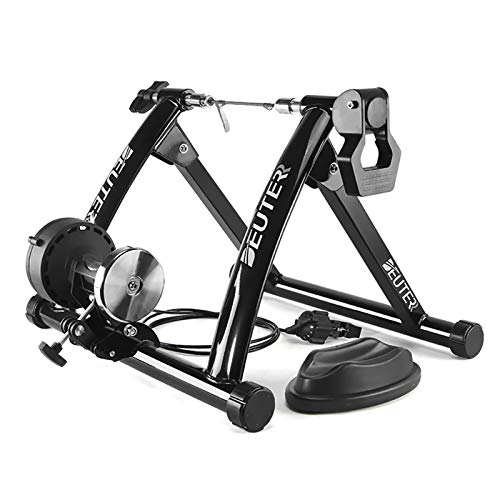
Budget Wheel-On Choice – Magnetic Indoor Bike Trainer
This folding magnetic trainer is a practical starting point for indoor cycling, but it is not a smart trainer with built-in Zwift control. Riders looking for bike trainers with zwift compatibility should note that the six resistance levels are adjusted from the handlebars rather than automatically by an app.
Best For: Riders who want an affordable, portable indoor stand for manual training.
Pros:
- Fits 26- to 29-inch wheels and 700C bicycles.
- Six handlebar-adjustable magnetic resistance levels.
- Folding design supports easier storage and transport.
- Includes a quick-release skewer and front wheel riser block.
Cons:
- It does not list Bluetooth, ANT+, or automatic Zwift resistance control.
- Rough MTB tires may produce more noise and vibration.
- Wheel-on contact requires attention to tire and roller setup.
This trainer makes sense for basic riding indoors when app-controlled resistance is not essential. For interactive Zwift workouts, consider a smart model instead or verify external sensor compatibility separately.
Feature-Rich Smart Trainer – CYCPLUS R200 Smart Bike Trainer
The CYCPLUS R200 is a smart direct-drive-style option for riders seeking bike trainers with zwift compatibility and broad app support. Dual-mode BLE and ANT+ connectivity, high power output, and automatic terrain simulation give it the features needed for immersive indoor sessions.
Best For: App-connected riders who want powerful training features and virtual shifting support.
Pros:
- Supports Zwift and MyWhoosh through BLE and ANT+ connectivity.
- 2200W peak power, up to 19% incline simulation, and stated ±1% power accuracy.
- Supports self-powered or plug-in operation.
- Includes adapters for quick-release and thru-axle setups, plus a two-year manufacturer warranty.
Cons:
- Cassette is not included.
- Virtual shifting requires the separately sold CYCPLUS BC2 Shifter.
- Virtual shifting is not compatible with ERG mode.
The R200 offers a strong balance of connectivity and realistic resistance features. Factor in the cassette and optional shifter costs, especially if you want the complete virtual-shifting setup.
Power Pick – ThinkRider X2Max Smart Trainer
For riders comparing bike trainers with Zwift compatibility, the ThinkRider X2Max stands out as a direct-drive smart trainer with dual ANT+ and Bluetooth connectivity. It delivers up to 2,000 watts, simulates gradients up to 18%, and automatically adjusts resistance when paired with compatible cycling software such as Zwift.
Best For: Riders who want high power capacity, app-controlled gradient simulation, and a stable indoor setup.
Pros:
- Supports both ANT+ and Bluetooth protocols and works with Zwift and other mainstream cycling software.
- Provides up to 2,000W of power with claimed power-meter accuracy of ±2%.
- Simulates slopes up to 18% for a more realistic virtual-riding experience.
- I-beam triangular frame is designed for balance and stability.
Cons:
- Cassette is not included.
- At 35.2 pounds, it is less convenient to move than lighter wheel-on trainers.
The X2Max is the strongest choice here for demanding virtual training, especially if you value responsive resistance changes and broad connectivity. Be sure to factor in the separate cassette when planning your setup.
Easy Smart Setup – Saris M2 Smart Indoor Trainer
Saris M2 Smart Indoor Bike Trainer, Compatible with Zwift App, Black, Made in the USA
Check Price On AmazonThe Saris M2 is a wheel-on option for shoppers seeking bike trainers with Zwift compatibility without removing the rear wheel. Its electromagnetic resistance connects through ANT+ FE-C or Bluetooth, while the included quick-release skewer supports common road and mountain bike frames.
Best For: Riders who want straightforward setup, app connectivity, and controlled electromagnetic resistance.
Pros:
- Wheel-on design avoids removing the bike’s rear wheel.
- Zwift certified and compatible with ANT+ FE-C and Bluetooth standards.
- Electromagnetic resistance provides a measured, consistent workout.
- Includes a steel quick-release skewer for common road and mountain bike frames.
Cons:
- Claimed accuracy is ±5%, less precise than the ThinkRider X2Max specification.
- Noise is listed at 69 decibels at 20 mph.
- Requires a compatible quick-release setup; the notes do not specify thru-axle compatibility.
The M2 is a practical smart-trainer choice when convenience matters more than maximum power. Its wheel-on installation and Zwift certification make it approachable for regular indoor sessions.
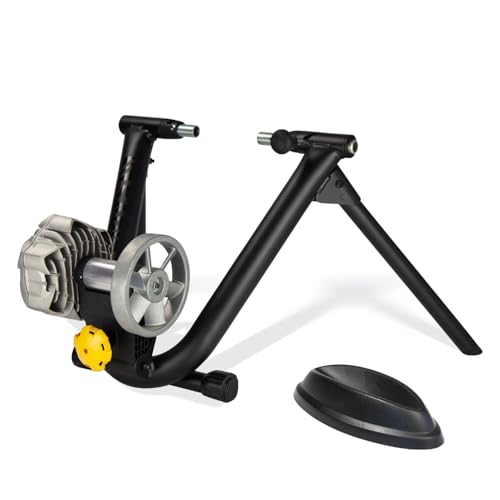
Budget-Friendly Classic – Saris Fluid2 Indoor Trainer
The Saris Fluid2 is a simple wheel-on trainer for cyclists considering bike trainers with Zwift compatibility at a lower-tech entry point. Its fluid resistance provides a progressive road-like feel, while a separate speed or cadence sensor enables use with platforms such as Zwift and Rouvy.
Best For: Riders who prefer a foldable, easy-to-store trainer and are comfortable adding a sensor for virtual training.
Pros:
- Fluid resistance increases progressively as you pedal harder.
- Foldable frame and wheel-on installation simplify setup and storage.
- Precision-balanced flywheel is designed for smooth, quiet performance.
- Fits road, mountain, and hybrid bikes.
Cons:
- Requires a separately sold speed or cadence sensor for Zwift connectivity.
- It is not presented as a fully integrated smart trainer with built-in app-controlled resistance.
- Listed noise level is 69 decibels.
The Fluid2 makes sense for riders who want dependable indoor resistance and occasional virtual riding rather than automatic terrain simulation. Include the cost of a compatible sensor when comparing it with smart trainers.
How We Picked These Bike Trainers with Zwift Compatibility
We focused on trainers that can work with Zwift through compatible ANT+ or Bluetooth connections, either directly or with the appropriate smart accessory. The selection includes direct-drive trainers for accurate power measurement and realistic resistance, wheel-on models for simpler setup, and conventional trainers suited to riders who want a lower-cost path into virtual cycling.
We also considered stated power capacity, simulated gradients, accuracy claims, drivetrain compatibility, connectivity, noise, portability, and whether the trainer requires external power. Specifications can vary by firmware, cassette or freehub configuration, bike type, and software setup, so verify current compatibility before buying.
Quick Comparison
- Best overall setup: Choose a modern direct-drive smart trainer with broad drivetrain support and reliable wireless connectivity.
- Best for realistic gradients: Look for high maximum incline simulation and strong resistance capacity, especially if you ride steep virtual routes.
- Best for quiet training: Direct-drive trainers generally produce less drivetrain and tire noise than wheel-on designs.
- Best for convenience: Models supporting both self-powered and plug-in operation can be easier to use in different locations.
- Best budget approach: A magnetic or fluid trainer paired with a compatible speed sensor can provide basic Zwift access, but it will not match automatic resistance control.
Key Buying Factors for Bike Trainers with Zwift Compatibility
Smart Control and Connectivity
For the full Zwift experience, choose a trainer that can transmit power and receive resistance commands over Bluetooth or ANT+. Check whether your computer, tablet, or phone supports the required connection and whether you need a separate ANT+ dongle.
Direct Drive Versus Wheel-On
Direct-drive trainers replace the rear wheel and usually deliver better power consistency, lower noise, and more realistic resistance. Wheel-on trainers retain your bike’s rear wheel, making them easier to store and install, but tire wear, calibration, and pressure can affect readings.
Power, Accuracy, and Gradient Simulation
Higher wattage and incline ratings benefit powerful riders, sprint training, and steep virtual climbs. Accuracy matters for racing and structured workouts, while casual riders may prioritize smooth resistance and dependable connectivity over the smallest measurement differences.
Bike and Drivetrain Compatibility
Confirm cassette, freehub, axle, and derailleur compatibility before ordering. Some direct-drive models require a cassette purchase or a specific freehub body. Also check clearance for mountain bikes, disc brakes, thru-axles, and unusual frames.
Who Should Buy Which Bike Trainers with Zwift Compatibility?
Serious racers and structured-training riders should favor an accurate direct-drive smart trainer with automatic resistance changes. Frequent indoor cyclists will appreciate quieter operation, broad compatibility, and easy calibration. New Zwift users and occasional riders may save money with a wheel-on trainer and sensor-based setup. Riders with limited storage should prioritize folding designs and simple wheel-on installation. Finally, high-power riders should compare maximum wattage and incline simulation rather than choosing solely by price.