The best bike computers with Komoot make turn-by-turn navigation easier while keeping speed, distance, elevation, and other ride data visible at a glance. The right model can reduce phone dependence and help you stay on route through unfamiliar roads and trails.
We compared 10 GPS cycling computers across navigation, display quality, battery life, sensor compatibility, connectivity, and everyday usability to help you choose the best fit for commuting, training, touring, or adventurous rides.
Best 10 Bike Computers with Komoot Picks for 2026
Best Komoot Navigation Value

- Imports routes from Komoot and Strava
- 3.3-inch touchscreen with button control
- Voice prompts and automatic rerouting
Best For: Everyday riders wanting practical Komoot navigation
Best Premium Smart Features

- Vivid 3.5-inch touchscreen and course creation
- Built-in speaker and bike-bell function
- Advanced climbing, power, and group-ride tools
Best For: Serious cyclists seeking premium navigation and training
Best Touchscreen Route Experience

- Focused touchscreen map and data interface
- Multi-band GNSS for accurate tracking
- ANT+, Bluetooth, SRAM AXS, and e-bike support
Best For: Tech-focused riders who value maps and accessory connectivity
Best Long-Distance Komoot Bundle

- Komoot syncing with offline navigation
- 50-hour battery for extended rides
- Includes heart-rate, cadence, and speed sensors
Best For: Gravel, bikepacking, and long-distance riders
Compact Komoot Navigator

- Imports Komoot routes with turn-by-turn prompts
- Up to 20 hours of battery life
- ANT+ radar and wireless sensor support
Best For: Riders wanting compact Komoot navigation and radar integration
Touchscreen Route Explorer
- Worldwide offline maps with off-course warnings
- Shares ride data to Komoot and Strava
- 130-plus metrics with ANT+ and Bluetooth
Best For: Riders wanting touchscreen maps and broad e-bike support
Long-Range Komoot Tourer

- Imports Komoot routes with turn-by-turn guidance
- Dual-band GPS for challenging environments
- Up to 25 hours of battery life
Best For: Touring riders wanting a larger display and extended battery
Flexible Route Companion

- Imports routes from Komoot and other platforms
- 25-hour battery with IPX7 water resistance
- Supports 100+ data fields and ANT+/Bluetooth sensors
Best For: Everyday riders seeking long battery life and flexible route support
Long-Range Navigation Pick
- Syncs completed rides to Komoot through Bryton Active
- 2.8-inch color touchscreen with offline USA maps
- 30-hour battery and automatic off-route rerouting
Best For: Long-distance riders wanting touchscreen navigation and connected training
Customizable Training Navigator

- Color GPX navigation with automatic rerouting
- Wi-Fi, Bluetooth, ANT+, and smart-trainer support
- 108 data items with highly customizable screens
Best For: Data-focused riders combining outdoor navigation with indoor training
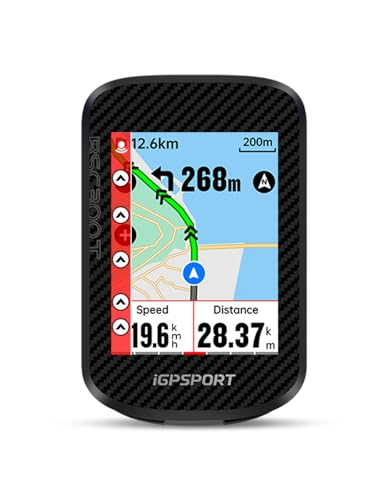
Best Komoot Navigation Value – iGPSPORT BSC500
For riders seeking practical bike computers with komoot integration, the iGPSPORT BSC500 combines Komoot route importing with a large touchscreen, voice guidance, and automatic rerouting. Its dual-band positioning and support for GPS, BeiDou, GLONASS, Galileo, and QZSS add confidence when following unfamiliar routes.
Best For: Riders who want Komoot route support, voice navigation, and flexible touchscreen-or-button control at a practical feature level.
Pros:
- Imports routes from Komoot, Strava, and other sources through the iGPSPORT app.
- 3.3-inch touchscreen displays up to 12 cycling data fields per page.
- Voice navigation, speed-based turn alerts, and automatic off-course rerouting.
- Dual-band, multi-satellite positioning and IPX7 water resistance.
Cons:
- The supplied information does not specify battery runtime.
- Some route and training features depend on the iGPSPORT app or compatible accessories.
The BSC500 is a strong choice when Komoot compatibility and clear route guidance matter more than premium training extras. Its combination of voice prompts, rerouting, and dual control methods makes it especially approachable for everyday navigation.
Best Premium Smart Features – Garmin Edge 1050
The Garmin Edge 1050 is a premium option among bike computers with komoot, pairing a vivid 3.5-inch touchscreen with advanced navigation, training, and connected-ride features. It is designed for cyclists who want detailed performance feedback alongside course planning and riding awareness.
Best For: Performance-focused road cyclists who want a large display, advanced training tools, group-ride connectivity, and premium navigation features.
Pros:
- Large color touchscreen supports course creation directly on the device.
- Built-in speaker provides workout and navigation prompts plus a bike-bell function.
- ClimbPro, power guidance, Garmin Coach, road-hazard alerts, and GroupRide add extensive functionality.
- Offers up to 20 hours in demanding use or up to 60 hours in battery-saver mode.
Cons:
- Its premium feature set may be more than casual riders need.
- Several connected features require a compatible smartphone, Garmin Connect, or additional sensors.
The Edge 1050 stands out for riders who want navigation to be part of a broader training and connectivity ecosystem. Its speaker, mapping tools, and extensive performance features make it a particularly capable upgrade for serious cyclists.
Best Touchscreen Route Experience – Hammerhead Karoo
The Hammerhead Karoo offers a focused touchscreen experience for cyclists comparing bike computers with komoot. Its hardware and software are built around managing maps and ride data with minimal distraction, while multi-band GNSS helps maintain accurate positioning across varied environments.
Best For: Riders who prioritize a polished touchscreen interface, precise mapping, and broad ANT+ and Bluetooth accessory compatibility.
Pros:
- 3.2-inch touchscreen is designed for direct map and ride-data control.
- Multi-band GNSS supports accurate tracking in urban and rugged environments.
- Connects with SRAM AXS products, e-bikes, ANT+ lights, and other accessories.
- Provides up to 15 hours of stated battery life.
Cons:
- Battery life is shorter than some long-distance cycling computers.
- The supplied notes do not specifically confirm Komoot route-import functionality.
The Karoo is appealing when the riding experience centers on responsive maps and a clean interface. Its accessory support also makes it a flexible hub for cyclists already using SRAM or ANT+ equipment.
Best Long-Distance Komoot Bundle – Bryton Rider S810
The Bryton Rider S810 is a compelling choice among bike computers with komoot for riders planning long days, bikepacking trips, and remote routes. It combines Komoot syncing with offline navigation, a 50-hour battery, a large color touchscreen, and a complete heart-rate, cadence, and speed sensor bundle.
Best For: Long-distance and gravel riders who want offline maps, extended battery life, included sensors, and Komoot synchronization.
Pros:
- Syncs ride records and routes with Komoot through the Bryton Active app.
- 50-hour battery and GPS-based offline navigation suit extended adventures.
- 3.5-inch color touchscreen includes an adaptive light sensor and tactile buttons.
- Bundle includes smart heart-rate, cadence, and speed sensors.
Cons:
- The sensor bundle may be unnecessary for riders who already own compatible sensors.
- Its larger feature set may require more setup than a basic cycling computer.
The S810 is particularly well matched to riders who cannot rely on cell service or frequent charging. With Komoot syncing, onboard rerouting, long battery life, and included performance sensors, it offers an adventure-ready package.
Compact Komoot Navigator – Wahoo ELEMNT BOLT V3
The Wahoo ELEMNT BOLT V3 is a compact choice for riders comparing bike computers with komoot. It can import Komoot routes, automatically download saved routes when accounts are synced, and provide on-device turn-by-turn prompts with LED and audible cues.
Best For: Road and trail riders who want compact navigation with strong Komoot integration and sensor support.
Pros:
- Imports Komoot routes and supports GPX and TCX files with turn-by-turn directions.
- Automatically downloads saved routes and uploads completed rides to authorized accounts.
- Offers up to 20 hours of battery life, IPX7 protection, and ANT+ radar integration.
- Supports on-device route generation and smartphone-based live tracking.
Cons:
- The 2.3-inch LCD is smaller than the ROAM V3’s display.
- Smart notifications and live tracking require a smartphone connection.
- Uses button controls rather than a touchscreen.
With its 84 g body, handlebar mounts, wireless connectivity, and dependable route workflow, the BOLT V3 is a practical pick when you want Komoot navigation without a larger cycling computer.
Touchscreen Route Explorer – iGPSPORT BSC300T
The iGPSPORT BSC300T combines offline maps, a 2.4-inch touchscreen, and Komoot sharing support for riders seeking bike computers with komoot. It supports route previews, turn prompts, off-course warnings, and worldwide offline map downloads, while its ANT+ and Bluetooth connectivity accommodates a broad range of riding sensors.
Best For: Riders who prioritize touchscreen map navigation, extensive ride data, and compatibility with road, MTB, and e-bike setups.
Pros:
- Supports worldwide offline maps, route previews, turn prompts, and off-course warnings.
- Connects with the iGPSPORT app to analyze and share rides to Komoot and Strava.
- Provides more than 130 riding metrics, including speed, grade, cadence, and temperature.
- Offers five-satellite positioning, real-time tracking, and ANT+/Bluetooth 5.0 support.
Cons:
- A Type-C charging cable is not included.
- Touchscreen operation may add complexity compared with button-only computers.
- Some software update information is unspecified in the supplied details.
The BSC300T stands out for riders who want map-based navigation and a large data set in a lightweight 67 g computer, especially if offline routing and e-bike compatibility matter.
Long-Range Komoot Tourer – Wahoo ELEMNT ROAM V3
The Wahoo ELEMNT ROAM V3 is designed for riders comparing bike computers with komoot for longer or more exploratory rides. It accepts Komoot routes and other route files, provides turn-by-turn prompts, and adds dual-band GPS for improved positioning in dense urban areas and wooded environments.
Best For: Touring and adventure riders who want a larger display, extended battery life, and reliable route guidance.
Pros:
- Imports Komoot, GPX, and TCX routes with automatic turn-by-turn guidance.
- Dual-band GPS supports enhanced accuracy where signals may be obstructed.
- Provides up to 25 hours of battery life and a 2.8-inch, 480×800 display.
- Supports on-demand route generation and public route sharing through the ELEMNT app.
Cons:
- At 109 g, it is heavier than the BOLT V3 and BSC300T.
- The supplied details list only one year of manufacturer warranty.
- Its route-generation and sharing features depend on the ELEMNT app workflow.
The ROAM V3 is the stronger fit when visibility, battery endurance, and GPS confidence matter more than minimizing size and weight. Its Komoot import support makes it well suited to planned touring routes.
Flexible Route Companion – iGPSPORT BSC200S
The iGPSPORT BSC200S is a practical choice among bike computers with komoot for riders who want straightforward route guidance, broad sensor compatibility, and long battery life. Routes can be created in the iGPSPORT app or imported from services including Komoot, Strava, and Ride with GPS.
Best For: Riders wanting affordable route navigation, extensive ride metrics, and up to 25 hours of battery life.
Pros:
- Imports Komoot and other third-party routes and supports turn, yaw, and direction reminders.
- Offers a readable 2.4-inch color display with a semi-reflective design for sunlight.
- Supports Bluetooth and ANT+ sensors, iGPSPORT lights, radar lights, and more than 100 data fields.
- IPX7 water resistance and a 25-hour battery support longer rides.
Cons:
- Navigation routes are created or imported through the companion app.
- The supplied package does not include a Type-C charging cable.
The BSC200S stands out for its combination of Komoot route importing, customizable data pages, and useful safety-oriented connectivity. Its button controls and compact 67-gram design keep the focus on essential ride information.
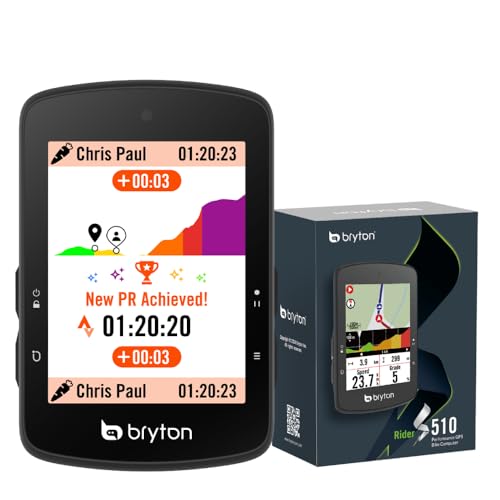
Long-Range Navigation Pick – Bryton Rider S510
The Bryton Rider S510 is a strong option for riders comparing bike computers with komoot, especially those who want a larger touchscreen, offline map support, and automatic post-ride syncing. Its Bryton Active App can sync ride data to Komoot, Strava, and TrainingPeaks.
Best For: Cyclists who prioritize touchscreen navigation, long battery life, and connected training features.
Pros:
- Provides a vivid 2.8-inch color touchscreen designed for visibility in bright sunlight.
- Offers up to 30 hours of battery life and on-device rerouting without requiring phone signal.
- Supports offline USA maps, turn-by-turn follow-track navigation, and compatible bike radar.
- Connects with ANT+ power meters, smart trainers, and other cycling accessories.
Cons:
- Komoot syncing is handled through the Bryton Active App rather than described as native on-device route planning.
- The supplied details do not specify the complete accessory package.
With its responsive color touchscreen and 30-hour runtime, the S510 is well suited to long rides and riders who prefer a more interactive interface. Predictive climbing and Strava Live Segments add useful training context beyond basic navigation.
Customizable Training Navigator – GEOID CC600
The GEOID CC600 is worth considering among bike computers with komoot for riders who want colorful GPX navigation, automatic rerouting, and extensive data customization. It can export FIT files and automatically sync cycling data with supported services such as Strava and TrainingPeaks.
Best For: Data-focused cyclists who want customizable screens, fast GPS positioning, and indoor-training support.
Pros:
- Supports external GPX routes, turn reminders, zooming, and automatic rerouting when you leave the planned track.
- Offers Wi-Fi and Bluetooth for faster transfers, AGNSS updates, and firmware updates.
- Provides up to 108 data items, 10 pages, and multiple chart and layout options.
- Works with Bluetooth and ANT+ sensors, smart trainers, radar lights, and electronic shifting systems.
Cons:
- The supplied notes do not specifically confirm direct Komoot route syncing.
- Its 24-hour battery life is shorter than some long-endurance alternatives.
The CC600’s main advantage is flexibility: riders can tailor the display extensively while using colorful navigation and automatic rerouting on the road. Wi-Fi connectivity and indoor-training functions also make it a versatile choice for cyclists who use the computer beyond outdoor navigation.
How We Picked the Best Bike Computers with Komoot
We focused on the features that matter most when using Komoot-planned routes on a bicycle: dependable GPS positioning, clear route guidance, readable screens, simple route syncing, and practical battery life. We also considered compatibility with ANT+ and Bluetooth sensors, waterproofing, touchscreen controls, offline maps, rerouting, and support for accessories such as radar or action cameras.
The selection includes compact computers for streamlined rides, larger touchscreen units for easier map viewing, and premium models with advanced training, group-riding, and performance features. Since specifications and software support can change, check the manufacturer’s current compatibility information before purchasing.
Quick Comparison
- Best premium feature set: Garmin Edge 1050, with a vivid display, built-in speaker, advanced metrics, and broad ecosystem support.
- Best for responsive navigation: Hammerhead Karoo, designed around detailed maps, touchscreen interaction, and frequent route guidance.
- Best for long rides: Bryton Rider S810, with a large display and up to 50 hours of stated battery life.
- Best compact Wahoo option: ELEMNT BOLT V3, suited to riders who want focused navigation and data in a smaller format.
- Best for larger route views: Wahoo ELEMNT ROAM V3, offering a more touring-friendly form factor.
- Best value-oriented choices: iGPSPORT BSC200S, BSC300T, BSC500, and GEOID CC600, depending on the display and navigation features you need.
Key Buying Factors for Bike Computers with Komoot
Komoot Route Support and Navigation
Look for straightforward route transfer from Komoot, clear turn prompts, off-course warnings, and rerouting when available. Offline maps are especially useful where mobile coverage is limited, but verify whether map regions require an account, app setup, or additional purchases.
Screen Size and Controls
A larger color display is easier to read while navigating complex junctions, whereas a compact screen keeps the computer lighter and may improve battery efficiency. Touchscreens are convenient for browsing maps, but physical buttons can be easier to operate with gloves or in wet conditions.
Battery Life and Charging
Match claimed runtime to your longest typical ride, allowing extra capacity for navigation, brightness, sensors, and cold weather. Riders touring or entering endurance events should prioritize extended battery modes, USB-C charging where available, and easy access to replacement or backup power.
Sensors, Connectivity, and Durability
ANT+ and Bluetooth support allow pairing with heart-rate monitors, cadence sensors, power meters, electronic shifting, and radar. Check compatibility before buying. IP-rated water resistance is important for exposed riding, while Wi-Fi can simplify software updates and route transfers.
Who Should Buy Which Bike Computers with Komoot?
Choose a premium Garmin or Hammerhead if you want advanced training data, rich mapping, touchscreen control, and a broad set of connected features. Choose Wahoo if you prefer a straightforward cycling computer with dependable route handling and an established companion-app experience.
Choose Bryton if long battery life, a large screen, and offline navigation are high priorities. Choose iGPSPORT or GEOID if you want core GPS routing and ride metrics at a potentially lower cost. Before deciding, prioritize the navigation workflow you will actually use: route syncing, map visibility, rerouting, sensor pairing, or extended battery life.