The right slant board can make calf stretching, heel-elevated squats, ankle-mobility drills, and lower-leg recovery easier to perform consistently. For athletes, the best choice balances a useful range of angles with reliable traction and enough stability for repeated training.
We selected 10 slant boards with different strengths, including wide wooden platforms, portable foldable designs, high-capacity frames, and multifunctional balance options. Use the guide below to match the board to your training goals, space, and experience level.
Best 10 Slant Boards for Athletes Picks for 2026
Best Overall
StrongTek Adjustable Wooden Slant Board

- Five angles from 15° to 35°
- Anti-slip treads and durable hardwood plywood
- Side handle for easier carrying
Best For: Athletes wanting a sturdy, versatile stretching and rehab board
Most Versatile
3-in-1 Slant and Balance Board
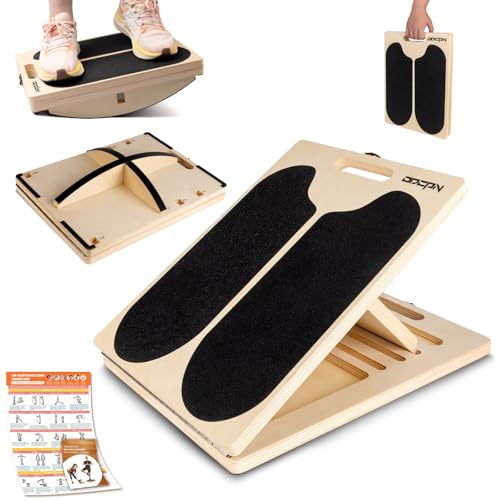
- Six adjustable angles up to 45°
- Adds 180° and 360° balance modes
- Folds flat with magnetic side panels
Best For: Athletes combining stretching with balance and coordination training
Best Portable Pick
StrongTek Wide Foldable Slant Board

- 13-inch-wide platform for natural foot placement
- Five angles from 15° to 35°
- Folds flat with built-in carry handle
Best For: Athletes needing a wide, portable board for mobility and squats
Best for Heavy Loads
EVERYMATE Wide Squat Slant Board

- Extra-wide 19.7-inch platform
- Full anti-slip top, baffle, and base
- Stated maximum load of 1,000 pounds
Best For: Athletes focused on wide-stance squats and high-load training
Heavy-Duty Adjustable Pick

- 660-pound stated capacity with steel frame
- Five angles from 15 to 40 degrees
- Non-slip surface and foldable, no-assembly design
Best For: Athletes who prioritize stability and multiple incline settings
Wide-Stance Training Pick
EXURA Adjustable Wide Slant Board

- Independent platforms support asymmetric foot angles
- 900-pound stated capacity for heavy training
- Rubber grips and base mats help limit movement
Best For: Lifters needing flexible stance and foot-position options
Portable Mobility Pick
Adjustable Wooden Calf Stretch Board

- Five angles from 23 to 45 degrees
- Folds and weighs 4.6 pounds
- Includes workout poster and instructions
Best For: Athletes wanting a simple, portable stretching board
Best with Extra Features
Frylr Foldable Adjustable Slant Board

- Four incline settings from 20° to 40°
- Folding design with carry handle
- 500-pound support rating and non-slip features
Best For: Portable daily mobility, stretching, and squat practice
Best for Rehabilitation
Portable Wooden Calf Stretch Board

- Four positions from 30° to 45°
- Lightweight wooden construction
- Suitable for stretching and rehabilitation training
Best For: Progressive mobility work and physical therapy settings
Best Angle Range
Five-Position Wooden Slant Board
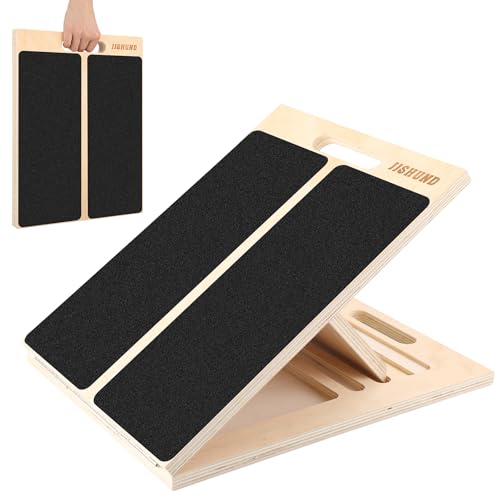
- Five angles from 20° to 45°
- Foldable 4.8-pound design with handle
- Anti-slip top and bottom grip pad
Best For: Progressive stretching and adjustable athletic mobility work
Best Overall – StrongTek Adjustable Wooden Slant Board
For athletes seeking dependable slant boards for athletes, this StrongTek model combines five incline settings with a wooden construction and anti-slip treads. Its side carry handle also makes it practical for warm-ups, cooldowns, squats, and mobility work at home or in a gym.
Best For: Athletes and rehab users who want an adjustable, therapist-recommended stretching board with a sturdy wood build.
Pros:
- Five adjustable angles from 15° to 35° support progressive stretching.
- Anti-slip treads help provide secure footing during calf stretches and squats.
- Hardwood plywood construction and a side handle support durability and portability.
- Useful for calf and ankle mobility, warm-ups, recovery, and rehabilitation exercises.
Cons:
- At 9 pounds, it is heavier than some portable slant-board options.
- The listed 12.5-by-16-inch size may be less convenient for very compact storage.
This is a strong all-purpose choice when stability, adjustable incline, and long-term wooden construction matter more than minimum weight.
Most Versatile – 3-in-1 Slant and Balance Board
This 3-in-1 option expands beyond basic calf stretching, making it one of the more versatile slant boards for athletes. It offers six incline angles plus 180° directional balance and 360° rotational balance modes, with detachable panels for switching between functions.
Best For: Athletes who want one compact board for calf mobility, balance practice, coordination, and core-focused training.
Pros:
- Six angles from 20° to 45° accommodate gentle through more demanding stretches.
- Three training modes combine slant stretching with 180° and 360° balance work.
- Portable design folds flat and includes magnetic quick-switch side panels.
- Includes a workout poster and instructions to support guided use.
Cons:
- Its maximum weight recommendation is listed as 300 pounds, despite a separate 460-pound capacity claim in the description.
- The multi-part design may require more setup and handling than a basic slant board.
Choose this model if balance and coordination training are priorities alongside calf stretching; a simpler board may be preferable for straightforward mobility work.
Best Portable Pick – StrongTek Wide Foldable Slant Board
For athletes who need a practical board for training and travel, this StrongTek model offers a 13-inch-wide platform, five incline settings, and a foldable body with an integrated carry handle. Its top and base both use anti-slip features for more secure workouts on hard floors.
Best For: Beginners, athletes, and rehab users who want a wide, foldable board for stretching, squats, lunges, and calf raises.
Pros:
- Five settings from 15° to 35° allow gradual progression.
- Extra-wide platform supports more natural foot placement for squats and lunges.
- Anti-slip abrasive top and rubber bottom pads improve stability and help protect floors.
- Supports up to 350 pounds and folds for compact storage or transport.
Cons:
- The 5.3-pound wood construction is less lightweight than the smallest travel boards.
- Its yellow-and-black color scheme may not suit every training space.
This is a well-balanced choice for athletes who value platform width, secure footing, and easy storage without giving up adjustable incline.
Best for Heavy Loads – EVERYMATE Wide Squat Slant Board
The EVERYMATE stands out among slant boards for athletes with its broad 19.7-inch platform and stated 1,000-pound maximum load. A full sandpaper surface, non-slip baffle, and anti-slip base are designed for secure calf stretching, ATG squats, VMO squats, and weighted movements.
Best For: Athletes who prioritize a wide stance and high stated load capacity for squat-focused training and mobility work.
Pros:
- Extra-wide 19.7-inch platform accommodates broad foot placement.
- Full sandpaper top, baffle, and base provide extensive anti-slip coverage.
- Hardwood plywood and bottom ribbed panels are designed for durability.
- Built-in handles support portability, and the board arrives fully assembled.
Cons:
- The specifications list one level, so it offers less clearly defined adjustability than multi-angle models.
- At approximately 6.9 pounds, it is not the lightest option for travel.
- The large footprint may be excessive for users seeking a compact calf stretcher.
This model makes the most sense for athletes who want generous stance width and a high stated load rating, particularly for squat-oriented training rather than compact portability.
Heavy-Duty Adjustable Pick – HANDBODE Wooden Slant Board
For athletes who want a sturdy, versatile option, the HANDBODE is one of the more substantial slant boards for athletes. Its steel frame supports up to 660 pounds, while five angle settings cover calf stretching, ankle mobility, heel raises, and squat preparation.
Best For: Athletes seeking a stable, adjustable board for regular mobility work and lower-body training at home or in a gym.
Pros:
- Five angles from 15 to 40 degrees support gradual progression.
- Steel frame and multilayer wood platform have a stated 660-pound capacity.
- Sand-grain surface helps maintain traction with bare feet, socks, or training shoes.
- Folds for storage and requires no assembly.
Cons:
- Its 12 x 15.7-inch platform may feel limited for users wanting a very broad stance.
- The relatively robust steel-and-wood construction may be less convenient to transport than a lighter board.
The HANDBODE stands out when stability, adjustability, and a high stated weight capacity matter more than minimal size. The five settings also make it easier to tailor stretching and squat work to your current mobility.
Wide-Stance Training Pick – EXURA Adjustable Wide Slant Board
The EXURA takes a different approach to slant boards for athletes with two independent metal platforms instead of one continuous surface. That design accommodates asymmetric foot angles, wider stances, split squats, Bulgarian split squats, and Poliquin step-ups, while four incline levels support mobility and calf training.
Best For: Lifters and athletes who need independent foot positioning for squat variations, heel elevation, and targeted calf or ankle work.
Pros:
- Two separate platforms allow asymmetric angles and wider stance options.
- Four incline levels range from gentler mobility work to deeper calf stretching.
- Metal construction has a stated 900-pound capacity.
- Rubber top grips and base mats are designed to reduce shifting.
Cons:
- The split-platform layout may feel less natural for users who prefer a single board.
- It offers four levels, fewer than some five-angle alternatives.
- At 7.6 pounds, it is not the lightest portable option.
Choose the EXURA if foot placement is central to your training. Its independent platforms are particularly useful for uneven stances and unilateral or split-squat movements that a single wedge cannot easily accommodate.
Portable Mobility Pick – Adjustable Wooden Calf Stretch Board
This lightweight wooden model is a practical choice for athletes who want portable slant boards for athletes without complicated setup. It folds for transport, weighs 4.6 pounds, and provides five angles from 23 to 45 degrees for progressively more demanding calf, ankle, heel, and leg stretching.
Best For: Beginners, experienced exercisers, and athletes who want a simple folding board for home, gym, or travel use.
Pros:
- Five angle settings provide a range from easier to more challenging stretches.
- Folding design and 4.6-pound weight make it convenient to carry.
- Can be used with one or both feet for calf and lower-leg mobility work.
- Includes a workout poster and instructions.
Cons:
- The supplied notes list both a 460-pound capacity highlight and a 300-pound maximum weight recommendation, so buyers should use the more conservative figure.
- It has no stated warranty.
- The wooden construction may be less heavy-duty than the metal-frame alternatives.
This board makes the most sense when portability and straightforward stretching are priorities. Its broad angle range and included training poster offer a simple starting point, but the conflicting capacity information warrants extra care when selecting it for loaded exercises.
Best with Extra Features – Frylr Foldable Adjustable Slant Board
For athletes comparing slant boards for athletes, the Frylr offers a versatile mix of portability, angle adjustment, and sturdy wooden construction. Its four incline settings support warm-ups, calf stretching, mobility work, and squat practice, while the folding design makes it practical for home, office, or gym use.
Best For: Athletes who want a portable, durable slant board with multiple incline options.
Pros:
- Adjusts to 20°, 25°, 30°, and 40° for different stretching intensities.
- Folds compactly and includes a carry handle and magnetic closure.
- 12-layer wood construction is rated to support up to 500 pounds.
- Non-slip foot surface and bottom grip pads help create a planted setup.
Cons:
- At about 5 pounds, it is portable but not ultralight.
- Its four angle settings offer less adjustment range than some five-position boards.
The Frylr is a strong all-around choice for athletes who prioritize stability and convenient storage. Its broad angle range and folding frame make it especially useful for regular mobility routines and travel between home and the gym.
Best for Rehabilitation – Portable Wooden Calf Stretch Board
This portable wooden board is a practical option for athletes seeking slant boards for athletes that can support stretching, physical therapy, and gradual mobility work. Four fixed angles accommodate different needs, and its lightweight design works in the home, office, gym, or physiotherapy clinic.
Best For: Beginners, athletes, and rehabilitation routines requiring straightforward angle adjustment.
Pros:
- Offers four incline positions: 30°, 35°, 40°, and 45°.
- Weighs about 4.5 to 5 pounds for reasonably easy transport.
- Designed for calf stretching, squats, mobility, and rehabilitation training.
- Wood construction suits home, gym, office, and clinic use.
Cons:
- Does not list a specific maximum weight capacity in the supplied details.
- The starting angle is 30°, so it may provide less gentle positioning than boards with a 20° setting.
This board makes sense for users who want a simple, portable tool for stretching and recovery rather than a heavily featured training platform. Its 45° setting can accommodate deeper stretching, while the intermediate positions support progression.
Best Angle Range – Five-Position Wooden Slant Board
Athletes who want more precise progression from gentle mobility to deep stretching may prefer this five-position option among slant boards for athletes. It includes angles from 20° to 45°, plus a textured top, bottom anti-slip pad, and hollow carry handle for training at home, outdoors, or in the gym.
Best For: Athletes who want five clearly defined angles for progressive stretching and training.
Pros:
- Provides five settings: 20°, 30°, 35°, 40°, and 45°.
- Foldable design weighs 4.8 pounds and includes a hollow handle.
- Enlarged panel with anti-slip sandpaper and a bottom grip pad helps limit movement.
- Thickened multilayer wood uses a triangular support structure.
Cons:
- Its stated load capacity is about 200 pounds, lower than some alternatives.
- The surface sandpaper may feel less comfortable for users who prefer a softer finish.
The main advantage here is the five-step angle progression, including a relatively gentle 20° starting point and a deep 45° position. It is a useful fit for athletes who want to adjust intensity across warm-ups, regular training, and deeper Achilles or calf stretching.
How We Picked the Best Slant Boards for Athletes
We focused on the features that matter during real training: adjustable incline range, platform width, surface traction, base stability, portability, weight capacity, and construction quality. We also considered whether each design suits calf stretching alone or supports broader uses such as heel-elevated squats, ankle-mobility work, balance training, and physical-therapy exercises.
Because athletes vary widely in size, strength, and mobility, the roundup includes both beginner-friendly fixed-feel options and more adjustable models. Product claims such as maximum capacity and angle range should still be checked against the manufacturer’s current specifications before purchase.
Quick Comparison
| Best For | Look For |
|---|---|
| Everyday calf stretching | A stable wooden wedge with a grippy top and base |
| Progressive mobility work | Several angle settings, preferably with easy adjustments |
| Squat assistance | A wide platform that keeps both feet secure |
| Large or powerful athletes | A reinforced frame and a clearly stated high weight capacity |
| Travel and storage | A foldable or compact board with a carry-friendly design |
| Balance training | A combination model with a stable slant surface and balance function |
Key Buying Factors for Slant Boards for Athletes
Angle Range and Adjustment
A lower angle is generally easier for beginners and useful for gentle mobility work, while steeper settings increase the demand on the calves and ankle range of motion. Multiple positions are valuable if you plan to progress gradually or share the board with other users.
Width, Traction, and Stability
Choose a platform wide enough to place your feet comfortably without hanging over the edges. A textured or rubberized top helps prevent slipping, while a non-slip base keeps the board planted on smooth flooring. For squats and loaded movements, stability matters more than a compact footprint.
Build Quality and Capacity
Wooden boards can be durable and comfortable, but inspect the frame, hinges, adjustment points, and base pads. If you are using weights or have a larger body size, select a model with a generous stated capacity and a reinforced support structure. Capacity ratings are not a substitute for controlled technique.
Portability and Storage
A foldable board is convenient for gyms, travel, or small homes. Fixed wooden wedges may take up more space but can feel simpler and sturdier. Consider where you will store the board and whether you need to carry it regularly.
Intended Use
Slant boards can support stretching and exercise, but they do not replace professional assessment for persistent pain or injury. Start at a comfortable angle, avoid forcing range of motion, and use the board as part of a balanced warm-up, strength, or recovery routine.
Who Should Buy Which Slant Boards for Athletes?
Beginners and users focused mainly on calf mobility should choose a stable board with a moderate angle range, clear adjustment steps, and strong traction. Athletes who also perform heel-elevated squats should prioritize a wide, rigid platform that stays secure under load.
Choose a high-capacity reinforced model if multiple people will use it or if strength training is the main purpose. A foldable design is the better fit for travel and limited storage, while a multifunctional balance board makes sense for users who want proprioception and balance drills in addition to stretching. If you need precise, gradual progression, favor models with five or more clearly defined angles.