Finding a dependable children’s bike does not require a premium budget. The best kids bicycles under $300 balance fit, braking confidence, manageable weight, and features that help young riders enjoy learning.
This roundup compares options for toddlers, beginning riders, older children, and trail-ready kids, including bikes with training wheels, BMX-inspired frames, mountain-bike styling, baskets, and multiple braking systems.
Best 10 Kids Bicycles Under 300 Picks for 2026
Comfort-Focused Pick

- Low-step frame and upright riding position
- Coaster and rear hand brakes
- Adjustable seatpost with quick assembly
Best For: Growing riders 47–53 inches tall riding on paved and urban routes
Trail-Ready Value
WEIZE 20-Inch Girls Mountain Bike

- Six-speed drivetrain for varied terrain
- Front suspension for bumps and vibrations
- 85% pre-assembled with setup guidance
Best For: Riders 46–57 inches tall using streets, park paths, and recreational trails
Size-Range Standout
- Available from 12- to 20-inch wheel sizes
- Training wheels on smaller versions
- Coaster and rear V-brake system
Best For: Families sizing bikes for children approximately ages 2–12
Beginner-Friendly Choice

- Training wheels for early balance practice
- Hand and coaster brakes
- Covered chain and adjustable fit
Best For: Beginning riders 35.4–41.3 inches tall, typically ages 3–5
Princess Pick
- Training wheels and imaginative princess styling
- Dual coaster and hand brakes
- Best for 34–38-inch beginners
Best For: Young riders who want a decorative starter bike
Growing Beginner

- Removable training wheels for learning
- Dual hand and coaster brakes
- Adjustable seat and handlebar
Best For: Beginner riders ages 4–6
BMX-Style Choice

- Simple single-speed drivetrain
- Front and rear caliper brakes
- Adjustable seat with colorful tires
Best For: Independent big-kid riders on roads and light trails
Trail-Ready Pick
WEIZE 20-Inch Dual-Suspension Mountain Bike

- Dual suspension helps absorb bumps.
- Six speeds suit changing terrain.
- Fits riders 42–56 inches tall.
Best For: Kids who ride on pavement, gravel, and light trails
Beginner Stability Pick
JMMD Kids Bike with Training Wheels

- Training wheels support early learning.
- Multiple brakes offer stopping options.
- Adjustable seat and handlebar accommodate growth.
Best For: Young beginners developing balance and confidence
Comfort-Focused Pick – Schwinn Elm 20-Inch Kids Bike
For families comparing kids bicycles under 300, the Schwinn Elm is a practical choice for growing riders who mainly ride on paved roads and around town. Its low-step frame, upright riding position, adjustable seatpost, and dual braking setup support a comfortable transition toward independent riding.
Best For: Growing riders 47–53 inches tall who need a comfortable neighborhood and school-ride bike.
Pros:
- Low-step frame and kid-sized contact points make mounting and handling easier.
- Rear coaster brake plus rear hand brake helps children practice hand braking.
- Tool-free adjustable seatpost, kickstand, and included riding bag add convenience.
- One-tool assembly and a limited lifetime frame warranty simplify ownership.
Cons:
- Single-speed drivetrain offers no gearing adjustment for hills.
- At 25.9 pounds, it may feel heavy for some younger riders.
- Designed for paved and urban terrain rather than mountain trails.
The Elm stands out when comfort, straightforward braking, and easy sizing matter more than trail capability or multiple gears.
Trail-Ready Value – WEIZE 20-Inch Girls Mountain Bike
Among kids bicycles under 300, this WEIZE mountain bike is suited to riders who want more versatility than a basic single-speed. Its six-speed drivetrain, front suspension, and caliper brakes make it a reasonable option for neighborhood streets, park paths, and recreational trails.
Best For: Girls ages roughly 6–11 and 46–57 inches tall who ride on mixed paved and unpaved recreational surfaces.
Pros:
- Six speeds provide more flexibility for varying riding conditions.
- Front suspension helps absorb bumps and reduce vibration.
- Front and rear caliper brakes provide responsive stopping control.
- Arrives 85% pre-assembled with instructions and online video guidance.
Cons:
- Brake performance may decrease in wet conditions.
- Steel construction may be less convenient to carry than a lighter frame.
- The 20-inch model’s sizing should be checked carefully against the child’s height.
This is the stronger match for families seeking entry-level trail capability and multiple gears, provided the rider fits the 20-inch size range.
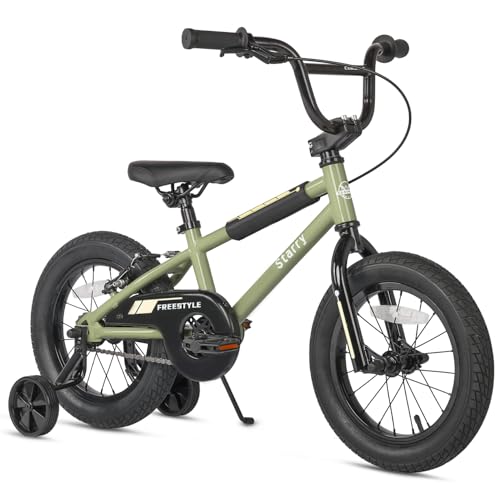
Size-Range Standout – Cubsala Starry BMX Kids Bike
For shoppers comparing kids bicycles under 300 across several age groups, the Cubsala Starry offers an unusually broad size range from 12 to 20 inches. Smaller versions include removable training wheels, while the 20-inch model is intended for older, more confident riders.
Best For: Families seeking a BMX-style bike that can match children from approximately ages 2–12 through multiple wheel sizes.
Pros:
- Five wheel-size options cover a wide range of rider heights and ages.
- 12-, 14-, 16-, and 18-inch versions include removable training wheels.
- Coaster and rear V-brake combination supports simple stopping control.
- Includes a kickstand, reflectors, tool kit, and lifetime frame warranty.
Cons:
- Single-speed drivetrain provides no gear range for hills.
- The 20-inch version does not include training wheels.
- High-tensile carbon steel construction may add weight.
The Starry is a flexible family option when matching the correct wheel size and deciding whether training wheels are needed are top priorities.
Beginner-Friendly Choice – WEIZE 14-Inch Kids Bike
This WEIZE model is a practical entry in the kids bicycles under 300 category for younger beginners. The 14-inch version combines training wheels, a covered chain, adjustable fit points, and both hand and coaster brakes for early practice on paved paths and neighborhood streets.
Best For: Beginning riders about 35.4–41.3 inches tall, typically ages 3–5, who need extra balance support.
Pros:
- Included training wheels provide added support while children learn to pedal and steer.
- Hand and coaster brakes introduce two stopping methods.
- Tool-free seat adjustment and an adjustable handlebar help refine the fit.
- Fully enclosed chain guard helps protect legs and loose clothing.
Cons:
- Single-speed design is intended for simple recreational riding.
- Training wheels may not suit children who are already comfortable balancing.
- The one-year warranty is shorter than the lifetime frame warranties listed for some alternatives.
Choose this model when stability and beginner-oriented safety features matter most, and confirm the child’s height before selecting the 14-inch version.
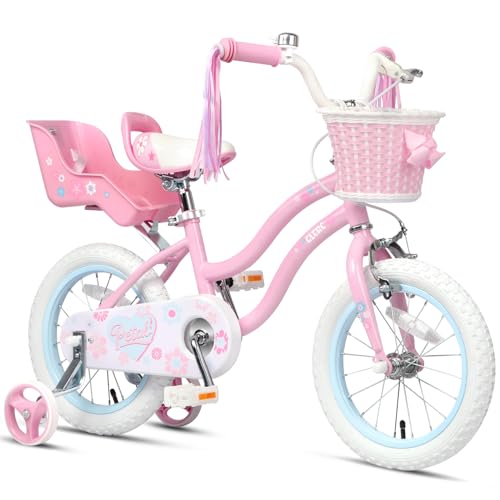
Princess Pick – Glerc Petal Girls Bike
For families comparing kids bicycles under 300, the Glerc Petal is a feature-filled option for younger riders who value playful styling. Its 12-inch size is designed for children approximately 34–38 inches tall with a 14–17-inch inseam.
Best For: Young beginners who want a princess-style bike with training wheels, a basket, and streamers.
Pros:
- Includes training wheels, basket, bell, doll seat, reflectors, and streamers.
- Dual braking combines a coaster brake with a hand brake.
- Low-straddle frame, adjustable seat, and child-friendly aluminum brake levers support easier handling.
- Arrives 85% pre-assembled with basic tools and a lifetime frame warranty.
Cons:
- The 12-inch version weighs 23 pounds, which may feel substantial for some very young riders.
- Its single-speed, rigid design is intended primarily for paved roads.
This is a style-forward starter bike with practical beginner features. Check your child’s inseam and height carefully, since the supplied sizing guidance is more useful than age alone.
Growing Beginner – WEIZE 16-Inch Kids Bike
Among kids bicycles under 300, the WEIZE 16-inch model stands out as a practical beginner bike for everyday paved-path riding. It is recommended for children ages 4–6 and approximately 38–48 inches tall.
Best For: Beginner riders who need training wheels now but may transition to two-wheel riding later.
Pros:
- Removable training wheels support the move from assisted to independent riding.
- Dual braking provides a front hand brake and rear coaster brake, with an adjustable lever angle.
- Adjustable seat and handlebar help accommodate growth and improve fit.
- Full chain guard, front and rear fenders, bell, and reflectors add everyday practicality.
Cons:
- It has a single-speed drivetrain and rigid suspension, limiting versatility on rough terrain.
- The steel frame may not feel as light as some alternatives.
With adjustable contact points and removable training wheels, this WEIZE is a sensible choice for a child developing balance and braking skills. Confirm the recommended height range before ordering.
BMX-Style Choice – 20-Inch Kids BMX-Style Bike
For older children shopping among kids bicycles under 300, this 20-inch BMX-style bike keeps the controls simple while adding a sportier look. Its single-speed drivetrain is suited to smooth urban roads and light off-road riding.
Best For: Big-kid riders who want a lightweight-feeling BMX-style bike with adjustable seating and colorful tires.
Pros:
- Single-speed setup keeps riding and control straightforward.
- Front and rear caliper brakes provide responsive stopping.
- Adjustable seat and low-span frame support fit and easier mounting.
- Non-slip colorful tires are designed for grip and visual appeal.
Cons:
- No training wheels are listed, so it is better suited to children who already balance independently.
- It has rigid suspension and no included accessories beyond a tool kit.
This bike offers a simple transition into a larger-wheel, BMX-inspired format. Its 20-inch size and big-kid positioning make height and riding ability especially important when choosing.
Trail-Ready Pick – WEIZE 20-Inch Dual-Suspension Mountain Bike
If you are comparing kids bicycles under 300 for neighborhood rides, parks, and occasional dirt paths, this WEIZE mountain bike offers a versatile setup for riders 42–56 inches tall. Its 20-inch wheels, six speeds, and dual suspension are suited to children who are ready for more varied terrain.
Best For: Riders ages 6–13 who want a geared bike for paved paths, gravel, and light trail use.
Pros:
- Front fork and rear shock absorber help smooth uneven surfaces.
- Six-speed drivetrain supports changing hills and riding conditions.
- Front and rear V-brakes provide direct hand-operated braking control.
- Arrives 85% pre-assembled and includes a one-year limited warranty.
Cons:
- Final assembly and adjustments are still required before riding.
- Its mountain-bike features may be more than needed for simple flat-surface riding.
Choose this model when comfort and terrain flexibility matter more than a lightweight, single-speed design. Check the child’s height first, since the supplied fit range is more useful than age alone.
Growing-Rider Value – WEIZE BMX-Style Kids Bike
For families comparing kids bicycles under 300 for everyday neighborhood riding, this WEIZE BMX-style bike keeps the design straightforward. It is available in 16- and 20-inch configurations, with the smaller version including removable training wheels and the larger version using a kickstand.
Best For: Young riders learning basic cycling skills on roads, paths, and neighborhood surfaces.
Pros:
- Hand brake and rear coaster brake offer two stopping methods.
- Adjustable seat supports fit changes as children grow.
- 16-inch version includes removable training wheels.
- Fenders and an enclosed chain guard add practical everyday protection.
Cons:
- The bike uses a single-speed drivetrain with no gear range.
- Wheel size must be selected carefully: the 16-inch and 20-inch versions have different fit ranges.
- At 21 pounds for the listed 16-inch model, it may not feel especially light to every child.
This is a sensible choice for beginners who value simple operation and familiar BMX styling. Confirm the wheel size against the rider’s height, particularly when choosing between the training-wheel-equipped 16-inch model and the 20-inch version.
Beginner Stability Pick – JMMD Kids Bike with Training Wheels
Among kids bicycles under 300, this JMMD model focuses on stability and beginner-friendly control. The 14-, 16-, and 18-inch options include training wheels, while the adjustable seat and handlebar help accommodate growing children.
Best For: Toddlers and young riders who are building balance and confidence before riding independently.
Pros:
- Training wheels provide added stability for beginners.
- Short-pull handbrake, front caliper brake, and coaster brake support stopping control.
- Adjustable seat and handlebar can adapt as the child grows.
- Chain guard helps protect little feet from the moving chain.
Cons:
- It is a single-speed bike, so it lacks gearing for hills or varied terrain.
- Training wheels may need to be removed as riding skills improve.
- The product notes do not specify a precise rider-height range for each wheel size.
The JMMD is a practical starting point when balance support and multiple braking options are priorities. Its adjustable components and included setup tools make it easier to configure as a child progresses from supported practice toward two-wheel riding.
How We Picked the Best Kids Bicycles Under 300
We focused on the factors that matter most for everyday family riding: age and height flexibility, wheel-size choices, braking design, safety-oriented components, ease of assembly, and likely riding use. The selection covers smaller first bikes, transitional models, BMX-style bicycles, and mountain-bike options for older children.
We also considered practical ownership details such as chain protection, kickstands, training wheels, suspension, and included accessories. Because children grow quickly, the best value is not always the bike with the most features; it is the model that fits well now while offering an appropriate path to the next riding stage.
Quick Comparison
| Best For | Look For | Useful Features |
|---|---|---|
| First-time riders | 12–16-inch wheels and stable geometry | Training wheels, coaster brake, chain guard |
| Growing children | 16–20-inch wheels and adjustable components | Hand and coaster brakes, kickstand |
| Older kids | 20–24-inch wheels and a better reach | Hand brakes, multiple gears, lighter frame |
| Rougher paths | Mountain-bike frame and durable tires | Suspension, wider tires, stronger braking |
| Style-focused riders | Comfortable fit with appealing details | Baskets, streamers, BMX styling |
Key Buying Factors for Kids Bicycles Under 300
Wheel Size and Fit
Wheel size is a starting point, not a substitute for checking the child’s height and inseam. A properly fitted bike should let the rider reach the controls comfortably and place a foot down when stopped. Avoid buying a significantly oversized bicycle simply to extend its useful life; poor fit can make learning harder and reduce control.
Brakes and Rider Experience
Coaster brakes are simple for beginners because the rider pedals backward to stop. Hand brakes offer better control as children become more confident, but they require enough hand strength and coordination. Models that combine both systems can ease the transition between riding stages.
Weight, Protection, and Assembly
A lighter bicycle is generally easier for a child to steer, start, stop, and recover from a wobble. Full or partial chain guards help protect clothing and fingers, while reflectors and a bell improve visibility and awareness. After assembly, check handlebar alignment, brake operation, wheel security, and tire pressure before the first ride.
Intended Terrain
For sidewalks, driveways, and paved paths, a simple single-speed bike is often the most practical choice. Mountain-bike features make more sense for packed trails and uneven surfaces, but suspension and larger frames can add weight. Match the equipment to where the child will actually ride.
Who Should Buy Which Kids Bicycles Under 300?
Choose a small bike with training wheels, a coaster brake, and protective chain coverage for a child who is still developing balance and pedaling skills. A 16- or 20-inch model with dual brakes is a better fit for a growing rider learning to move from beginner controls to hand braking.
For children who prefer tricks, casual neighborhood riding, or a sportier appearance, a BMX-style bicycle is a practical direction. Older or taller riders who use gravel paths and mild trails should consider a 20- or 24-inch mountain-bike option, provided the frame is not too heavy and the controls fit their hands.
Finally, prioritize fit over color or accessory count. A basket, streamers, or suspension may improve appeal, but the right size, reliable brakes, secure assembly, and a properly fitted helmet matter more for safe, enjoyable riding.