Smart bike rollers make indoor cycling more engaging by combining balance-focused riding with adjustable resistance, connected training, or both. The right model can help you maintain fitness, practice handling, and complete structured workouts without taking up a permanent amount of floor space.
This roundup compares 10 roller-style trainers and related indoor cycling options, from connected systems such as the Wahoo KICKR ROLLR to compact folding and magnetic designs. Use the guide below to match features, compatibility, and training goals to your setup.
Best 10 Smart Bike Rollers Picks for 2026
Best Smart Roller Stand

- No wheel or cassette removal
- Bluetooth and ANT+ connectivity
- 1,500W capacity with 10% grade
Best For: Connected training with quick bike setup
Best Foldable Rollers

- Folding space-saving frame
- Three magnetic resistance levels
- Works with Rouvy and Kinomap
Best For: Compact home training and app-supported rides
Best Adjustable Aluminum Rollers

- Adjustable 950–1,180 mm wheelbase
- Lightweight aluminum frame
- Three settings with air resistance
Best For: Road bikes and longer wheelbases
Best No-Power Rollers

- Tapered rollers center wheels
- No power required
- Folds for compact storage
Best For: Simple indoor riding and balance practice
Smart Training Pick

- Wheel-on setup keeps installation simple
- ANT+ and Bluetooth app connectivity
- Electromagnetic resistance with ±5% accuracy
Best For: Connected indoor training with a rear wheel left in place
Balance-Focused Pick

- Tapered rollers help center wheels
- No power required or maintenance needed
- Folds for storage and includes a mat
Best For: Traditional, portable roller training
Portable Resistance Pick

- Five magnetic resistance levels
- Fits 16-inch to 29-inch wheels
- Folding aluminum design for travel
Best For: Compact training, travel, and event warm-ups
Quiet Compact Pick
Minoura MOZ G2 Folding Rollers
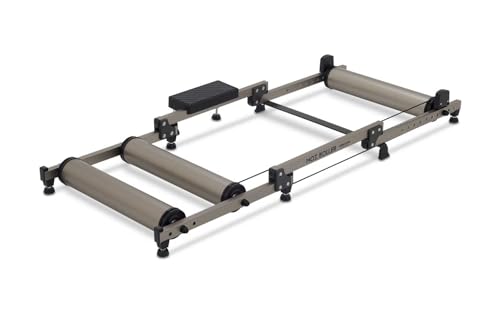
- Three-section folding design
- Fits 20-inch BMX to 700C wheels
- Noise insulators and step guard
Best For: Portable, quieter indoor training with broad wheel-size compatibility
Portable Magnetic Option
ROCKBROS Foldable Bike Rollers

- Parabolic rollers for added stability
- Magnetic resistance mechanism
- Fits 16- to 29-inch bikes
Best For: Portable MTB, road, and folding-bike training
Seven-Position Trainer

- Seven front-wheel adjustment positions
- Three-point stability design
- Foldable and designed for reduced noise
Best For: Compatible 24- to 29-inch and 700C bikes needing flexible fit
Best Smart Roller Stand – Wahoo KICKR ROLLR
The Wahoo KICKR ROLLR is a practical choice among smart bike rollers if you want connected indoor training without removing your bike’s wheel or cassette. Its front-wheel clamp, Bluetooth and ANT+ connectivity, and stated 1,500-watt capacity make it suited to structured workouts.
Best For: Riders who want a connected roller trainer with quick bike setup and broad tire compatibility.
Pros:
- No wheel removal or cassette installation required.
- Front-wheel clamp fits most bikes with tires up to 2.1 inches.
- Supports Bluetooth and ANT+ connections, with resistance up to 1,500 watts and 10% grade simulation.
Cons:
- At 25 kg, it is relatively heavy to move or store.
- The supplied notes specify a one-year manufacturer warranty.
The KICKR ROLLR stands out for convenience and connectivity rather than compact portability. It is a strong fit for riders who prioritize easy bike placement and app-compatible training.
Best Foldable Rollers – Elite Arion Mag
The Elite Arion Mag is a useful option for riders comparing smart bike rollers with a focus on storage and manual control. Its folding composite frame has three magnetic resistance levels and works with Rouvy and Kinomap for interactive training.
Best For: Apartment riders and home-gym users who need foldable rollers with adjustable resistance.
Pros:
- Folding design helps reduce storage space.
- Three manual magnetic resistance levels support varied workouts.
- Compatible with Rouvy and Kinomap apps for interactive sessions.
- Supports road and mountain bikes with a 150 kg load capacity.
Cons:
- Resistance is adjusted manually rather than through a stated wireless control system.
- The supplied dimensions and composite construction may not suit riders seeking a full-size metal frame.
The Arion Mag balances portability, straightforward resistance adjustment, and app compatibility. It is a sensible choice when folding storage matters as much as training flexibility.
Best Adjustable Aluminum Rollers – Minoura LiveRoll R730R
The Minoura LiveRoll R730R is a straightforward choice among smart bike rollers for riders who value an adjustable aluminum frame and long-wheelbase compatibility. Its three-piece design accommodates wheelbases from 37.4 to 46.5 inches and uses air resistance.
Best For: Road cyclists who need adjustable rollers for different wheelbases, including longer bikes.
Pros:
- Compatible with wheelbases from 950 to 1,180 mm.
- Lightweight aluminum frame construction.
- Three settings and air resistance provide adjustable training intensity.
Cons:
- The supplied notes identify it primarily for road bikes.
- No included components are listed.
- Air resistance does not provide the stated app connectivity of some connected trainers.
The LiveRoll R730R is best viewed as an adaptable, mechanically simple roller setup. Its adjustable wheelbase range makes it more flexible than fixed-size designs for compatible road bikes.
Best No-Power Rollers – Garmin TacX Antares
The Garmin TacX Antares is a maintenance-free option for riders shopping for smart bike rollers without needing a powered setup. Its tapered rollers help center the wheels, while the retractable frame folds for storage and fits bikes with 26- to 29-inch wheels.
Best For: Riders seeking simple, no-power indoor rollers with a stable, space-conscious design.
Pros:
- Tapered rollers help keep the wheels centered.
- Requires no power and is described as maintenance free.
- Folds down to 31.5 by 18.5 by 5.31 inches for storage.
- Fits bikes with 26- to 29-inch wheel diameters.
Cons:
- It lacks the Bluetooth or ANT+ connectivity listed for some smart trainers.
- The supplied notes do not specify a load capacity or resistance settings.
The Antares prioritizes uncomplicated indoor riding over connected features. Its tapered rollers and folding design make it a practical pick for basic balance practice and compact storage.
Smart Training Pick – Saris M2 Smart Trainer
The Saris M2 is a practical choice for cyclists seeking smart bike rollers without removing the rear wheel. Its electromagnetic resistance, app connectivity, and Zwift certification support structured indoor training.
Best For: Riders who want connected training with a wheel-on setup.
Pros:
- Connects to common road and mountain bikes without removing the rear wheel.
- Works with indoor cycling apps through ANT+ FE-C and Bluetooth; Zwift certified.
- Provides controlled electromagnetic resistance with stated accuracy of plus or minus 5%.
- Includes a steel quick-release skewer and one month of Rouvy.
Cons:
- At 20 pounds, it is less convenient to move than more compact trainers.
- Its stated noise level is 69 decibels at 20 mph.
- The wheel-on design may require attention to tire setup and rear-wheel contact.
Choose the M2 if app-based workouts and consistent electronic resistance matter more than the smallest possible footprint. Its 300-pound load capacity and broad bike compatibility add flexibility for home training.
Balance-Focused Pick – Garmin TacX Antares Rollers
Garmin TacX Antares Indoor Retractable Bicycle Rollers 62 cm & TacX Rollable Trainer Mat
Check Price On AmazonThe Garmin TacX Antares is a straightforward option among smart bike rollers for riders who prefer a traditional, power-free roller setup. Its tapered rollers help keep the wheels centered, while the included mat helps protect floors and reduce riding noise.
Best For: Cyclists who want maintenance-free rollers and a foldable storage design.
Pros:
- Tapered rollers help keep the wheels centered for improved stability.
- Requires no power and is maintenance free.
- Fits bikes with 26-inch to 29-inch wheels.
- Folds down to 31.5 by 18.5 by 5.31 inches and includes a rollable trainer mat.
Cons:
- It does not provide the app connectivity or electronic resistance listed for the Saris trainer.
- The roller design requires the rider to balance the bike while riding.
- The stated load capacity is 40 pounds.
The Antares suits riders who value simplicity, portability, and centered wheels over connected workout control. The included mat makes the package more practical for indoor use.
Portable Resistance Pick – CXWXC Adjustable Bike Trainer
The CXWXC trainer is a portable alternative for shoppers comparing smart bike rollers and basic indoor resistance stands. Its magnetic unit offers five resistance levels, while the adjustable fork mount supports several wheel and axle configurations.
Best For: Riders who need a compact, adjustable trainer for travel or warm-ups.
Pros:
- Offers five magnetic resistance levels through a control knob.
- Supports 16-inch to 29-inch wheels and includes QR and multiple thru-axle adapters.
- Aluminum construction and a folding design make transport and storage easier.
- Can be set up for indoor training or warming up and cooling down at events.
Cons:
- It is not described as app-connected or electronically controlled.
- The manufacturer notes some front-end sway during riding.
- Thru-axle installation requires careful, accurate adapter placement.
This model makes sense when portability and axle flexibility are priorities. Consider another design if maximum stability or connected training features are essential.
Quiet Compact Pick – Minoura MOZ G2 Folding Rollers
The Minoura MOZ G2 is a practical choice among smart bike rollers for riders who want a compact, easy-to-store setup. Its three-section folding design, adjustable rear roller, and detachable step guard make it especially convenient for regular indoor training.
Best For: Riders who prioritize portability, quiet operation, and compatibility with bikes from 20-inch BMX models through 700C sizes.
Pros:
- Three-section folding design simplifies storage and transport.
- Adjustable rear roller accommodates 20-inch BMX through 700C wheels.
- Noise insulators support quieter operation, while the detachable step guard helps with mounting and dismounting.
- Lightweight, rustproof alloy construction is easy to handle.
Cons:
- Only one listed setting may offer less adjustment flexibility than some competing rollers.
- The supplied details do not identify a resistance mechanism or connected smart features.
Choose the MOZ G2 if simple setup, broad wheel-size compatibility, and compact storage matter more than advanced resistance controls or app-based training features.
Portable Magnetic Option – ROCKBROS Foldable Bike Rollers
The ROCKBROS roller stand is a flexible option for shoppers comparing smart bike rollers with portable indoor trainers. Its parabolic roller shape is designed for added stability, while the foldable aluminum frame and magnetic resistance mechanism suit riders who want a compact exercise setup.
Best For: MTB, road, and folding-bike riders seeking a foldable trainer with magnetic resistance and compatibility across 16- to 29-inch wheel sizes.
Pros:
- Parabolic rollers are designed to improve stability compared with straight rollers.
- Foldable, lightweight design weighs about 6.5 kg for easier carrying and storage.
- Sealed bearings support smoother operation.
- Adjustable front mounting holes accommodate 16- to 29-inch bikes, including MTB, road, and folding models.
Cons:
- The supplied details list one setting, limiting documented adjustment options.
- Resistance is identified as magnetic, but no specific resistance levels are provided.
- Its listed load capacity is 250 pounds, so riders should check their total bike-and-rider weight.
This ROCKBROS model stands out for its portability and bike-size range. It is a sensible fit for riders who value foldability and magnetic resistance in a straightforward indoor trainer.
Seven-Position Trainer – Adjustable Blue Bike Rollers
This adjustable blue roller trainer is a practical choice among smart bike rollers for riders who need a flexible fit and compact storage. Seven front-wheel distance positions support several compatible bike types, while the three-point stability design is intended to make indoor riding easier.
Best For: Riders with compatible 24- to 29-inch or 700C MTB, road, and folding bikes who want multiple fit positions and a space-saving trainer.
Pros:
- Seven front-wheel bracket positions accommodate different bike models.
- Three-point stability design helps support steady riding.
- PP roller material is intended to reduce operating noise, useful in apartments or shared spaces.
- Foldable, lightweight construction is easy to move and store in narrow spaces.
Cons:
- Compatibility is listed for 24- to 29-inch and 700C bikes, so smaller wheels may not fit.
- The supplied details do not specify a resistance mechanism.
- The listed load capacity is 220 pounds.
Consider this model when adjustability and storage convenience are priorities. Its documented seven-position bracket and vibration-conscious construction give it a useful edge for varied indoor setups.
How We Picked These Smart Bike Rollers
We focused on roller and roller-style trainers that offer useful value for indoor cyclists, including connected control, adjustable resistance, portability, folding storage, tire and wheel compatibility, and stability. The selection includes true free-rolling designs, magnetic resistance models, and hybrid options so riders can compare different approaches rather than choosing from one narrow category.
We also considered practical setup details: whether a trainer is suitable for road or mountain bikes, how easily it can be moved, whether it supports apps such as Zwift, and whether accessories such as a riser block or mat may be needed. Product specifications can vary by seller, so verify current compatibility and included components before ordering.
Quick Comparison
| Type | Best For | What to Check |
|---|---|---|
| Connected roller or hybrid trainer | Interactive workouts and flexible riding | App support, power measurement, pairing, and bike fit |
| Parabolic rollers | Balance, cadence, and natural-feeling riding | Frame width, noise, resistance options, and learning curve |
| Magnetic roller trainer | Budget-friendly resistance training | Resistance range, tire size, stability, and adjustability |
| Folding rollers | Small homes and easy storage | Folded dimensions, locking mechanism, and weight |
Key Buying Factors for Smart Bike Rollers
Connectivity and Training Control
If structured workouts or virtual riding matter, look for Bluetooth or ANT+ support, dependable app compatibility, and a clear method for changing resistance. Some products are smart trainers, while basic rollers only provide mechanical resistance and do not transmit power or connect to training platforms.
Bike and Wheel Compatibility
Check the supported wheel range, tire width, axle or frame requirements, and whether the trainer accommodates your road, hybrid, or mountain bike. A roller that fits 700C wheels may not suit every smaller wheel or wide MTB tire. Also confirm whether the listed price includes adapters, a front-wheel support, or a riser block.
Stability, Noise, and Learning Curve
Free rollers require more balance than a fixed trainer, although parabolic drums can help guide the bike toward the center. A wide base, sturdy frame, and textured or well-machined drums improve confidence. Expect tire noise, especially at higher speeds, and use a level surface with adequate clearance.
Storage and Workout Space
Folding frames are useful when the trainer must be stored after every session. Measure both the operating footprint and folded size. A trainer mat can protect flooring, reduce vibration, and make cleanup easier, but it may be a separate purchase.
Who Should Buy Which Smart Bike Rollers?
Choose a connected or hybrid model if you want app-based workouts, resistance changes, or a more guided indoor training experience. Choose parabolic rollers if your priority is balance, cadence, and a road-like feel. Choose magnetic resistance rollers if you want adjustable effort at a lower cost and do not need advanced connectivity.
Choose a folding model for apartments, shared rooms, or cyclists who travel with their equipment. Riders using mountain bikes should prioritize tire and wheel clearance, while beginners should favor a stable frame and keep the first sessions easy. Regardless of type, place the trainer on a firm level surface, keep a wall or support nearby while learning, and confirm every specification before purchase.