Table tennis robots make solo practice more structured by delivering repeatable balls without requiring a training partner. Models under $300 range from simple beginner launchers to app-controlled machines with adjustable spin, speed, and placement.
Our selection focuses on practical features that affect everyday training, including control options, ball capacity, portability, drill variety, and ease of setup. Use the guide below to match the right robot to your practice goals and available space.
Best 10 Table Tennis Robots Under 300 Picks for 2026
Best Feature-Rich Pick

- 264 preset and customizable drills
- App and remote control
- 150-ball capacity with adjustable spin
Best For: Players and coaches wanting detailed, programmable practice
Best Remote-Control Value

- Wireless control for spin and speed
- Adjustable head for two serve styles
- One-year normal-wear replacement support
Best For: Players seeking adjustable practice without app controls
Best Simple Starter

- Includes 100 balls
- Supports solo practice
- Adjustable spin and speed
Best For: Beginners wanting a straightforward training machine
Best Lightweight Classic

- 2.5-pound lightweight design
- 110-ball capacity
- 12–70 balls-per-minute frequency
Best For: Players practicing basic topspin, underspin, and consistency
Versatile Spin Trainer

- Creates up to 36 spin variations
- Compact and easy to carry
- Requires 15+ standard 40 mm balls
Best For: Spin-focused solo practice
Best for Everyday Use
JOOLA iPong Play Trainer Robot

- Shoots up to 30 balls per minute
- Includes 20 ABS training balls
- Battery-powered and fully assembled
Best For: Beginner and casual practice
Advanced Practice Setup
WAYMARK HP-07 Table Tennis Robot
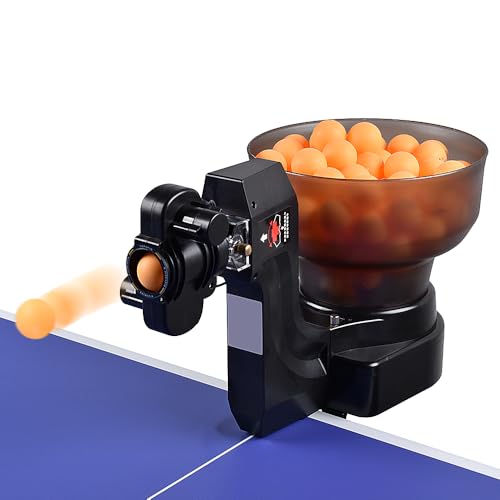
- Offers nine spin modes and adjustable speed
- Holds up to 120 balls
- Includes clamp mount and two-year warranty
Best For: Customizable intermediate and advanced drills
Lightweight Starter
Vbestlife Automatic Table Tennis Trainer

- Lightweight 664-gram design
- Simple one-switch operation
- Includes 10 practice balls
Best For: Beginners and casual indoor practice
Adjustable All-Rounder

- Wireless remote control
- Adjustable speed, frequency, direction, and spin
- Shoots up to 70 balls per minute
Best For: Solo drills with varied training settings
High-Capacity Trainer
ÜZXMOTO Adjustable Ping Pong Robot

- Holds approximately 120 balls
- Adjustable spin, speed, frequency, landing, and height
- Designed for 40mm standard balls
Best For: Adult players wanting longer customized sessions
Best Feature-Rich Pick – PONGBOT NOVA S Pro
For shoppers comparing table tennis robots under 300, the PONGBOT NOVA S Pro stands out for its extensive drill library and detailed controls. It offers app and remote operation, adjustable speed, spin, frequency, height, and landing point, plus 264 preset drills and custom programming.
Best For: Beginners, advanced players, and coaches who want highly customizable solo practice.
Pros:
- 264 preset drills with support for custom routines
- App and remote control adjust speed, spin, placement, and frequency
- 150-ball capacity with 30–90 balls-per-minute frequency
- Offers nine spin types and a one-year warranty
Cons:
- 40mm-plus balls and two AAA batteries are not included
- Its broad range of settings may take time to learn
The NOVA S Pro is the most versatile option in this group for structured, repeatable training. Its app-based landing-spot animation and near-net serve trajectory add useful practice variety for players working on placement and aggressive techniques.
Best Remote-Control Value – Suz S102 Table Tennis Robot
Among table tennis robots under 300, the Suz S102 is a straightforward choice for players who want remote-controlled solo practice. Its settings let you adjust spin, speed, serving style, and oscillation while the adjustable head supports direct or indirect serves.
Best For: Recreational and developing players who need an adjustable practice partner.
Pros:
- Wireless remote control adjusts spin, speed, frequency, and oscillation
- Adjustable head supports direct and indirect serves
- Manufacturer offers replacement parts for normal wear and tear within one year
Cons:
- Only fits tables less than 2.5 inches thick
- Proper operation requires at least 20 balls in the storage tube
- Setup and troubleshooting may require following the manual closely
The S102 offers useful control without relying on an app, but table compatibility is an important buying check. It can be a practical training aid if your table meets the thickness requirement and you are comfortable adjusting its setup.
Best Simple Starter – Suz S101 Ping Pong Machine
The Suz S101 is a basic option for shoppers searching for table tennis robots under 300 and wanting a dedicated solo-training machine. It is supplied with 100 balls and is designed to address the need for an available practice partner while allowing spin and speed adjustments.
Best For: Adult beginners and recreational players starting solo table tennis practice.
Pros:
- Includes 100 balls for getting started
- Supports solo training without a practice partner
- Allows spin and speed adjustment for drills
- Compact plastic construction weighs 4 kg
Cons:
- The supplied notes do not specify a remote, app, or drill library
- Color may be orange, white, or random
The S101 keeps the feature set focused on core practice functions. It may suit buyers who prefer a simpler machine and do not need the extensive programming or connectivity offered by more advanced robots.
Best Lightweight Classic – iPong Original Trainer
The iPong Original is a compact pick for shoppers comparing table tennis robots under 300. It holds up to 110 balls, delivers topspin and underspin, and adjusts its delivery rate from 12 to 70 balls per minute for solo drills.
Best For: Players who want a lightweight, quick-to-assemble robot for basic spin and consistency practice.
Pros:
- Holds up to 110 balls
- Adjustable frequency from 12 to 70 balls per minute
- Provides topspin and underspin settings
- Assembly takes under a minute and includes a remote
Cons:
- Spin options are limited to topspin and underspin
- The supplied notes do not mention custom drills or app control
At 2.5 pounds, the iPong is the lightest listed option and is convenient to set up and move. Its simpler controls make it better suited to foundational repetition than advanced placement programming.
Versatile Spin Trainer – 36-Spin Ping Pong Robot
If you are comparing table tennis robots under 300, this compact training machine stands out for its broad spin variety and adjustable placement. It supports solo practice with topspin, backspin, sidespin, and combined-spin drills, making it useful for players who want more than a basic ball launcher.
Best For: Players seeking varied spin practice in a portable, easy-to-install machine.
Pros:
- Delivers up to 36 different spinning-ball variations.
- Supports optional single or double-end serving with adjustable positioning.
- Compact 12-by-10-by-11-inch design weighs about 2.4 kg.
- Includes a one-year warranty for product-quality issues under normal use.
Cons:
- Requires at least 15 balls to operate and does not include balls.
- Uses standard 40 mm balls, so compatibility matters when choosing replacements.
- The falling point is not fixed, which may be less suitable for highly precise drills.
This robot offers an appealing balance of portability and spin variety, but buyers should budget for compatible balls and note the minimum-ball requirement before training.
Best for Everyday Use – JOOLA iPong Play Trainer Robot
JOOLA iPong Play Table Tennis Trainer Robot with 20 ABS Training Balls, Orange
Check Price On AmazonAmong table tennis robots under 300, the JOOLA iPong Play is a straightforward entry-level option for learning basic consistency. It launches up to 30 balls per minute, runs wirelessly on four AA batteries, and arrives assembled for quick practice at home or in an office.
Best For: Beginners who want a simple, portable ball launcher with included practice balls.
Pros:
- Arrives fully assembled and starts with the press of a button.
- Wireless battery operation makes placement flexible.
- Includes 20 quality 40 mm ABS training balls.
- Compact 12-by-7-inch design is easy to store or transport.
Cons:
- Four AA batteries are required but not included.
- Its listed output is up to 30 balls per minute, limiting higher-intensity sessions.
- Designed as an entry-level trainer rather than a highly customizable robot.
The iPong Play prioritizes convenience over advanced adjustment, making it a practical choice for beginners, casual practice, and buyers who want included balls and minimal setup.
Advanced Practice Setup – WAYMARK HP-07 Table Tennis Robot
For shoppers comparing table tennis robots under 300, the WAYMARK HP-07 offers a feature-rich setup for more demanding solo training. Its dual motors, nine spin modes, adjustable speed, oscillation, pitch, and 120-ball hopper support varied drills across multiple landing points.
Best For: Intermediate and advanced players who want adjustable, match-style training patterns.
Pros:
- Provides nine spin modes, including topspin, backspin, sidespin, and non-spin.
- Adjustable serving speeds are listed from 8.9 to 76 mph.
- 120-ball hopper supports longer practice sessions.
- Tool-free clamp fits tables up to 2.5 inches thick and includes a two-year warranty.
Cons:
- The ball-catch net is sold separately.
- At about 3.3 kg and 15.5 inches tall, it is less compact than simpler trainers.
- Although 50 balls are included, the hopper capacity is much larger than the included supply.
This is the most adjustable option of the three, with useful capacity and warranty coverage for regular training. Its larger footprint and need for a separate net may matter to buyers with limited space.
Lightweight Starter – Vbestlife Automatic Table Tennis Trainer
If you are comparing table tennis robots under 300 for basic solo practice, the Vbestlife trainer emphasizes simple operation and portability. It automatically feeds balls, uses a one-switch design, and includes 10 practice balls for getting started quickly.
Best For: Beginners, children, and casual indoor practice where a lightweight, easy-to-use launcher is the priority.
Pros:
- Lightweight 664-gram design is easy to carry.
- One-switch operation requires minimal setup.
- Large ball exit is designed for smooth delivery and fewer jams.
- Includes 10 balls and runs on four AA batteries.
Cons:
- Offers a basic training setup rather than advanced speed, spin, or frequency controls.
- Designed for indoor use according to the supplied details.
- Its 10-ball capacity requires frequent refilling.
This is a straightforward choice for first-time users who want repeatable ball feeding without complicated controls. More advanced players may prefer a robot with adjustable spin and speed.
Adjustable All-Rounder – iPong V300 Training Robot
For shoppers seeking table tennis robots under 300 with more training flexibility, the iPong V300 provides remote control over ball frequency, speed, direction, and spin. It also assembles quickly and can deliver up to 70 balls per minute.
Best For: Beginners through more experienced players who want adjustable solo drills and remote operation from across the table.
Pros:
- Wireless remote includes a memory button for convenient adjustments.
- Adjusts ball frequency from 30 to 70 balls per minute.
- Provides controls for speed, direction, topspin, and backspin.
- Twist-on assembly avoids app downloads and complicated instructions.
Cons:
- The supplied notes do not list included practice balls.
- At 3.1 pounds, it is less lightweight than the Vbestlife model.
- Its listed one-year warranty is standard but shorter coverage may be preferred by some buyers.
The V300 stands out when drill variety matters more than minimal size. Its remote and adjustable settings make it a practical option for structured practice without requiring a partner.
High-Capacity Trainer – ÜZXMOTO Adjustable Ping Pong Robot
ZXMOTO Table Tennis Robot Automatic Ping Pong Robot Machine for Training (HP-07)
Check Price On AmazonThe ÜZXMOTO is worth considering among table tennis robots under 300 if you want a larger ball supply and adjustable practice variables. Its container holds approximately 120 regulation-size 40mm balls, while controls cover spin, frequency, ball speed, landing, and height.
Best For: Adult players who want longer solo sessions with customizable ball placement and delivery.
Pros:
- Ball container accommodates approximately 120 40mm balls.
- Supports adjustments for spin, frequency, speed, landing, and height.
- Lets players operate the machine without staying at the table.
- Uses standard 40mm table tennis balls.
Cons:
- At 9.9 pounds, it is relatively heavy to move.
- The supplied warranty description is only one month.
- The notes do not specify an included ball supply.
This model is geared toward users who value capacity and customization over portability. Its short listed warranty is the main point to weigh carefully before purchase.
How We Picked the Best Table Tennis Robots Under 300
We compared these machines by looking at the features most likely to influence real-world practice. Control flexibility was a major consideration: wireless remotes and app controls make it easier to change drills without leaving the table. We also considered ball capacity, spin and speed adjustment, portability, included accessories, and whether each model is better suited to beginners, recreational players, or more structured training.
At this price, specifications can vary significantly. Some robots emphasize simple operation and compact storage, while others offer more extensive drill programming. We prioritized products that provide a clear training benefit rather than focusing on the largest feature list alone.
Quick Comparison
| Feature | What to Look For | Why It Matters |
|---|---|---|
| Controls | Remote or app operation | Lets you adjust settings during practice |
| Ball capacity | 10 to 150 balls or more | Higher capacity means fewer interruptions |
| Spin and speed | Adjustable settings or multiple spin types | Supports more realistic, progressive drills |
| Portability | Compact body and manageable setup | Useful for home tables and frequent storage |
| Included balls | Training balls supplied with the robot | Allows practice soon after unboxing |
Key Buying Factors for Table Tennis Robots Under 300
Ball Capacity and Feeding Consistency
A larger hopper is valuable for repetitive footwork and stroke sessions because it reduces refills. Smaller launchers can still work well for beginners, children, or short drills. More important than capacity alone is consistent feeding: irregular timing can make technique practice frustrating.
Spin, Speed, and Placement Controls
Look for independently adjustable speed and spin if you want to practice returns, topspin, backspin, or changing tempos. Basic models may offer fewer settings but can be easier to use. If you are developing technique, select a robot that can increase difficulty as your control improves.
Setup, Compatibility, and Storage
Confirm that the robot works with your table layout and uses the correct ball size. Consider the power connection, attachment or placement method, remote range, and storage footprint. A portable model is more likely to be used regularly, especially in shared spaces.
Training Goals
Some machines are best for repeating one stroke, while app-enabled or programmable models can support varied sequences. Decide whether you need basic ball launching, coaching assistance, or a wider range of solo practice drills before paying for advanced controls.
Who Should Buy Which Table Tennis Robots Under 300?
- Beginners: Choose a simple, compact machine with straightforward controls and a modest speed range.
- Casual home players: Prioritize portability, included balls, and quick setup over complex programming.
- Improving intermediate players: Look for adjustable spin, speed, timing, and a larger hopper for longer sessions.
- Structured solo trainees: App control, programmable drills, and broad placement options are worth considering.
- Coaches and families: Favor higher capacity and remote operation so multiple players can train efficiently.
Finally, check replacement-ball requirements and current pricing before ordering. A dependable, easy-to-use robot that fits your table and routine is usually a better investment than a feature-heavy model that is difficult to set up.