The best slant boards for stretching make it easier to maintain a consistent angle during calf, ankle, and lower-leg mobility work. Adjustable designs can also support squats, warmups, and physical-therapy-style exercises.
We compared 10 options across adjustability, traction, weight capacity, portability, and included accessories so you can choose a board that fits your routine and available space.
Best 10 Slant Boards for Stretching Picks for 2026
Premium Wooden Pick
Adjustable StrongTek Slant Board

- Five incline settings from 15° to 35°
- Durable Lauan hardwood plywood construction
- Anti-slip treads and side carry handle
Best For: Calf stretching, squats, and rehabilitation
Best Lightweight Option

- Weighs approximately 1 pound
- Five adjustable angle configurations
- Waterproof EPP foam is easy to clean
Best For: Portable stretching, squats, and office or travel use
Best Wide Platform
StrongTek Foldable Wooden Slant Board

- 13-inch-wide platform for comfortable foot placement
- Five settings from 15° to 35°
- Foldable design with carry handle
Best For: Squats, calf mobility, and users who prefer a wider board
Best Complete Set
Wooden Calf Stretch Board with Bands

- Five angles from 23° to 45°
- Includes two resistance bands
- Training poster and instruction manual included
Best For: Stretching, mobility work, and guided physical-therapy exercises
Best Modular Option

- Three-piece design with stackable 8.5° and 17° wedges
- Lightweight, durable EPP foam construction
- Supports stretching, squats, calf raises, and step-ups
Best For: Users wanting versatile wedge configurations for mobility and workouts
Best Portable Wooden Board
Five-Angle Folding Calf Stretcher

- Five settings from 23° to 45°
- Folds for transport and storage
- Includes workout poster and instructions
Best For: Home, gym, yoga, and travel stretching routines
Best All-Around Board
Adjustable Wooden Mobility Slant Board
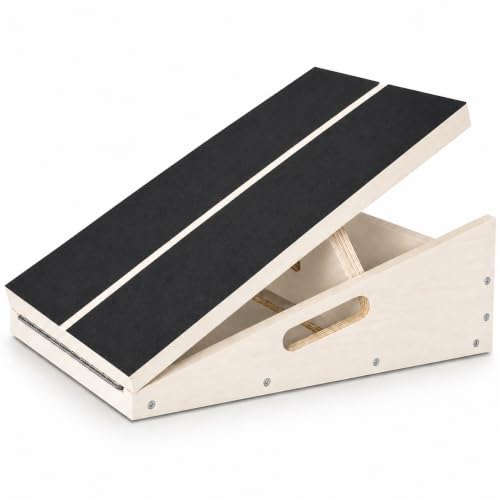
- Five angles from 15° to 35°
- Textured top and slip-resistant base
- Includes handle, exercise guide, and three-year warranty
Best For: Stretching, ankle mobility, squats, and warm-ups at home or the gym
Lightweight Adjustable Pick

- 4 adjustable angles from 30° to 45°
- Lightweight 4.5-pound construction
- Designed for stretching, squats, and rehab
Best For: Portable calf stretching and general lower-body mobility
Fine-Tuning Favorite

- 5 incline settings from 23° to 45°
- Stated 460-pound weight capacity
- Includes training poster and instructions
Best For: Progressive calf stretching, squats, and mobility work
High-Capacity Hardwood Option

- Four angles from 20° to 40°
- Stated 500-pound weight capacity
- Built-in handle and no assembly required
Best For: Portable stretching, squats, and ankle mobility drills
Premium Wooden Pick – Adjustable StrongTek Slant Board
If you want a sturdy, traditional option among slant boards for stretching, this StrongTek model combines a wooden build, five incline settings, and anti-slip treads. Its side handle also makes it easier to move between workouts, office use, or rehab sessions.
Best For: Users seeking a durable adjustable board for calf and ankle stretching, squats, and rehabilitation.
Pros:
- Five adjustable positions from 15° to 35° support progressive stretching.
- High-quality Lauan hardwood plywood construction is designed for durability.
- Anti-slip treads and a side carry handle add practical convenience.
- Suitable for stretching, squats, recovery, and multiple fitness levels.
Cons:
- At about 9 pounds, it is heavier than the foam and folding alternatives.
- The wooden design is less compact for travel than lightweight wedge-style boards.
This is a solid choice if stability and a substantial wood platform matter more to you than minimum weight. The five positions provide useful flexibility for beginners and experienced users alike.
Best Lightweight Option – Foam Squat Wedge Slant Board
This lightweight foam wedge stands out among slant boards for stretching when portability and easy cleanup are priorities. Its adjustable configurations offer multiple levels of incline, while the EPP construction is waterproof, oil-proof, and easy to wipe clean.
Best For: Travelers, office users, and exercisers who want a lightweight calf-stretching and squat aid.
Pros:
- Weighs only about 1 pound for easy carrying.
- Offers five angle options, including 8.5°, 17°, 25.5°, 34°, and 180° configurations.
- Supports up to 960 pounds according to the supplied product details.
- Waterproof, oil-proof, recyclable EPP material is simple to clean.
Cons:
- The smaller 12-by-6-inch board dimensions may provide less foot room than wider wooden models.
- Foam construction may feel less substantial than a full-size wood board.
Choose this model if you value low weight and flexible setup over a larger platform. Its detachable, foldable design is particularly convenient for carrying to different locations.
Best Wide Platform – StrongTek Foldable Wooden Slant Board
For shoppers comparing slant boards for stretching, this StrongTek model offers an extra-wide 13-inch platform, five incline settings, and a foldable design. Its textured top and rubberized base are intended to keep feet and the board secure during mobility work and squats.
Best For: Beginners, athletes, and rehab users who want a wider wooden platform with compact storage.
Pros:
- Five settings from 15° to 35° allow gradual progression.
- 13-inch width provides room for squats, lunges, and calf raises.
- Anti-slip top and base help improve traction and protect flooring.
- Foldable body and integrated handle simplify storage and transport.
Cons:
- Its 5.3-pound weight is heavier than the foam wedge option.
- The wooden platform may take more storage space than a compact foam wedge when in use.
This is a practical middle ground between stability and portability. The wide platform is useful if narrow slant boards make your stance feel cramped, while the folding design keeps storage manageable.
Best Complete Set – Wooden Calf Stretch Board with Bands
This wooden board adds resistance bands and an exercise guide to the usual slant-board setup, making it a versatile pick among slant boards for stretching. Five adjustable angles and non-slip materials support calf, ankle, knee, heel, and physical-therapy routines.
Best For: Users who want a stretching board bundled with resistance bands and guided exercises.
Pros:
- Five adjustable angles range from 23° to 45°.
- Includes two TPE resistance bands with different tension levels.
- Non-slip EVA base and PVC sandpaper surface are designed for secure use.
- Includes a training poster and instruction manual.
Cons:
- The supplied details list different maximum capacities, so shoppers should verify the current specification.
- Its angle range starts at 23°, offering less low-angle adjustment than some competing models.
- It is not the lightest option at approximately 4.5 pounds.
This set makes sense if you want more than a passive calf stretch. The included bands and guide add exercise variety, while the adjustable wooden board remains useful for mobility and rehabilitation work.
Best Modular Option – Stackable EPP Squat Wedge Set
For shoppers comparing slant boards for stretching, this set stands out for its modular design. It includes two 8.5° wedges and one 17° wedge, allowing you to create several configurations for calf stretching, heel-elevated squats, and other workouts.
Best For: Users who want adjustable wedge setups for stretching, squats, warm-ups, and broader exercise routines.
Pros:
- Stackable wedges provide multiple angle configurations.
- Lightweight, shape-retaining EPP foam construction.
- Silicone grip points help improve floor contact.
- Can also function as a calf-raise block or expanded aerobic step.
Cons:
- The modular design may be less straightforward than a single hinged board.
- The supplied set contains three pieces rather than one continuous platform.
This is a flexible choice for people who want more than a basic calf stretcher. Its stackable format supports gradual changes in incline, while the lightweight EPP construction makes it practical for home workouts and mobility sessions.
Best Portable Wooden Board – Five-Angle Folding Calf Stretcher
This portable wooden board is a practical pick among slant boards for stretching, especially if you want several incline levels without assembly. It folds for transport and offers five settings from 23° to 45° for progressively more demanding calf and lower-leg stretching.
Best For: Beginners and experienced exercisers who need a foldable board for home, gym, yoga, or physical therapy-style routines.
Pros:
- Five adjustable angles accommodate different stretching levels.
- Folding design makes it easier to carry and store.
- Suitable for calf, heel, ankle, leg, glute, and flexibility work.
- Includes a workout poster and instructions.
Cons:
- Its 23° starting angle may be less gentle than lower-angle boards.
- The listed product details contain different capacity figures, so shoppers should verify the applicable limit.
- No warranty is specified in the supplied details.
With five clearly defined angle choices and a foldable wooden construction, this model suits users who value portability and progression. The included poster is also helpful for those who want basic exercise guidance with the board.
Best All-Around Board – Adjustable Wooden Mobility Slant Board
This wooden slant board is a well-rounded option for shoppers seeking slant boards for stretching, ankle mobility, squats, and warm-ups. Its five settings range from 15° to 35°, giving beginners a lower starting angle while leaving room to progress.
Best For: Home, office, or gym users who want one sturdy board for stretching, mobility exercises, calf raises, balance drills, and squats.
Pros:
- Five angles provide a broad progression from 15° to 35°.
- Textured top and slip-resistant base support secure positioning.
- Wooden construction is rated for a 500-pound capacity.
- Side handle, exercise guide, and three-year warranty add convenience.
Cons:
- Wood construction weighs 3.85 kg, making it less lightweight than foam options.
- It is a single board rather than a modular system.
This model offers a useful balance of adjustability, stability, and versatility. The low 15° setting can be approachable for starting mobility work, while the textured surface, carry handle, exercise guide, and warranty make it a practical everyday option.
Lightweight Adjustable Pick – Portable Wooden Slant Board
If you want slant boards for stretching that are easy to move between rooms, this wooden model offers four incline settings in a compact, lightweight design. It can support calf stretching, squats, mobility work, and rehabilitation routines at home, in the office, gym, or clinic.
Best For: Beginners, athletes, and anyone seeking a portable board for calf stretching and lower-body mobility.
Pros:
- Lightweight 4.5-pound design for convenient portability.
- Four adjustable angles: 30°, 35°, 40°, and 45°.
- Suitable for stretching, squats, rehabilitation, and posture-related routines.
Cons:
- Offers fewer angle settings than some competing boards.
- The supplied dimensions may be less suitable for users wanting a larger standing surface.
This is a practical choice when portability and straightforward adjustability matter most. Its broad range of intended uses makes it suitable for general stretching and exercise, though users wanting more precise incline progression may prefer a five-angle design.
Fine-Tuning Favorite – 5-Angle Calf Stretch Board
Among slant boards for stretching, this model stands out for its five incline settings and stated 460-pound capacity. Its textured PVC surface, non-slip EVA base, and included training materials make it a versatile option for calf work, squats, warm-ups, and mobility exercises.
Best For: Users who want more gradual angle adjustments and a board suited to both stretching and strength routines.
Pros:
- Five settings from 23° through 45° for more gradual progression.
- 11-ply poplar construction with a stated 460-pound capacity.
- Textured top and non-slip base provide added traction.
- Arrives assembled with a training poster and instruction guide.
Cons:
- At 4.5 pounds, it may be heavier than some ultra-light alternatives.
- The board requires stable placement and angle-slot checks before use.
This is the strongest fit for shoppers prioritizing adjustability and setup guidance. The 23° starting angle can be useful for easing into a routine, while the higher settings accommodate more demanding stretches and squat variations.
High-Capacity Hardwood Option – TEMI Calf Stretching Board
For shoppers comparing slant boards for stretching, the TEMI board combines a portable hardwood design with four adjustable wedge angles. Its built-in handle, anti-slip surface, and stated 500-pound capacity support calf stretches, heel positioning, squats, balance work, and ankle mobility drills.
Best For: Users seeking a sturdy, portable board for stretching, squat positioning, and rehabilitation-focused mobility work.
Pros:
- Four angle options: 20°, 25°, 30°, and 40°.
- Stated 500-pound capacity with a high-density hardwood construction.
- Built-in handle and compact footprint make transport easier.
- No assembly required and backed by a stated one-year warranty.
Cons:
- Its maximum listed angle is 40°, lower than some 45° models.
- It provides four settings rather than the five available on some alternatives.
The TEMI is a well-rounded pick for portability and sturdiness, especially if a built-in handle and higher stated capacity are priorities. Its angle range favors controlled mobility work and heel elevation without requiring assembly.
How We Picked the Best Slant Boards for Stretching
We focused on the features that most affect safe, repeatable use: angle adjustment, platform width, surface grip, base stability, stated weight capacity, portability, and setup. The selection includes wooden incline boards, foam wedge blocks, stackable-angle designs, and models with useful extras such as training posters or resistance bands.
Because product specifications can vary by size and configuration, check the current listing for exact dimensions, included pieces, and capacity before ordering. A higher weight rating is useful, but it does not replace a secure non-slip base or controlled technique.
Quick Comparison
| Best For | Look For | Typical Advantage |
|---|---|---|
| Daily calf stretching | Adjustable angles and grippy surface | Easy progression over time |
| Squats and strength work | Wide, rigid platform and stable base | More consistent foot positioning |
| Travel or compact storage | Lightweight wedge or portable wood design | Quick setup and transport |
| Beginners | Low starting angle and clear instructions | More comfortable adaptation |
| Rehabilitation-style mobility | Fine angle control and strong traction | Measured, repeatable sessions |
Key Buying Factors for Slant Boards for Stretching
Angle Adjustment
Several incline settings let you begin gently and increase the stretch as mobility improves. A fixed wedge can be simpler, while five-position boards offer more flexibility for calves, ankles, and squat variations.
Traction and Stability
Look for a textured or rubberized standing surface plus a base that stays planted on your floor. Non-slip features matter especially on hard flooring, during loaded squats, or when the board is used barefoot.
Size, Width, and Capacity
A wider platform can feel more secure and accommodate different stances. Confirm the usable surface dimensions rather than relying only on the product title. Weight-capacity claims should comfortably exceed your body weight and any external load.
Construction and Portability
Wooden boards are typically rigid and stable, but they may be heavier than foam wedges. Consider handles, foldability, stackable components, and storage space if you plan to move the board between rooms or take it to a gym.
Included Accessories
A training poster can help with exercise ideas, while a resistance band may expand warmup options. Treat accessories as bonuses; the board’s angle range, grip, and stability should drive the decision.
Who Should Buy Which Slant Boards for Stretching?
Choose an adjustable wooden board if you want one durable platform for calf stretching, ankle mobility, and squats. It is the most versatile choice for regular home training.
Choose a foam wedge or squat wedge set if portability, low cost, or simple setup matters most. Stackable wedges are particularly useful when you want several angles without a mechanical adjustment system.
Choose a beginner-friendly model with a lower starting angle and clear guidance if you are new to slant-board work. Start with short, comfortable holds and increase intensity gradually.
Choose a higher-capacity, wide-base option for loaded squats or larger users, provided the surface remains stable on your floor. If you are using a board for injury recovery or have persistent pain, ask a qualified clinician which movements and angles are appropriate.