Adjustable slant boards can make calf stretching, ankle-mobility drills, squats, and lower-body warmups easier to perform consistently. The best choice depends on more than angle count: platform width, traction, weight capacity, portability, and build quality all affect how confidently you can use one.
We compared 10 adjustable options across these practical criteria to help you find a board that fits your training space, experience level, and preferred exercises.
Best 10 Adjustable Slant Boards Picks for 2026
Best Overall Wooden Option
StrongTek 5-Position Wooden Slant Board

- Five angles from 15 to 35 degrees
- 500-pound capacity with anti-slip treads
- Wood construction with a side carry handle
Best For: Portable stretching, squats, and rehabilitation
Best for Wide Stances
EXURA Dual-Platform Metal Slant Board

- Independent platforms support asymmetric foot angles
- Four incline levels for stretching and training
- 900-pound metal-frame capacity
Best For: Heavy training, split squats, and customized foot positioning
Best Full-Coverage Design

- Five incline positions from 15 to 35 degrees
- Full-coverage non-slip surface
- Wood construction with side carry handles
Best For: Home stretching, squats, and rehab with broad foot coverage
Best Lightweight Choice
Compact Adjustable Calf Stretch Board

- Progressive angles for calves and ankle mobility
- Wide wood platform with a non-slip surface
- Lightweight and requires no assembly
Best For: Portable daily stretching, desk use, and home workouts
Best Overall
StrongTek Adjustable Slant Board

- Five angles from 15° to 35°
- 13-inch-wide, non-slip platform
- 350-pound capacity with foldable handle
Best For: Beginners, athletes, and rehab users needing a wide, stable board
Best High-Capacity Pick

- Four angles from 20° to 40°
- 500-pound stated capacity
- Folding frame with magnetic closure and handle
Best For: Portable stretching and users wanting a high stated load capacity
Best for Deep Stretching
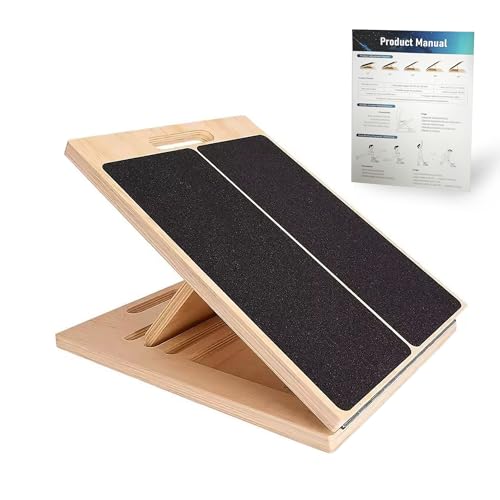
- Five settings up to a 45° incline
- 350-pound capacity with non-slip surface
- Folds flat and arrives fully assembled
Best For: Progressive stretching, Pilates, rehab, and users wanting a steeper angle
Best Portable Wooden Pick

- Four angles from 20° to 40°
- 500-lb stated weight capacity
- Lightweight with built-in handle
Best For: Portable calf stretching and squat positioning
Best Heavy-Duty Frame
HANDBODE Five-Angle Slant Board

- Steel frame rated to 660 lb
- Five angles from 15° to 40°
- Folding, non-slip design needs no assembly
Best For: Stable home-gym stretching and lower-body training
Best for Higher Inclines

- Four angles from 30° to 45°
- Lightweight at about 4.5 lb
- Designed for stretching and therapy routines
Best For: Portable mobility work with steeper inclines
Best Overall Wooden Option – StrongTek 5-Position Wooden Slant Board
For shoppers comparing adjustable slant boards, this StrongTek model combines five incline settings with a hardwood-plywood platform and a side handle. It is designed for calf and ankle stretching, squats, rehabilitation, and home-gym use.
Best For: Users who want a portable wooden board with multiple angle options for stretching, mobility work, and rehab exercises.
Pros:
- Five adjustable positions from 15 to 35 degrees.
- 500-pound capacity with anti-slip safety treads.
- Lauan hardwood plywood construction and a side handle for carrying.
- Requires no assembly and supports stretching, squats, and physical therapy.
Cons:
- The partial-coverage grip surface may provide less coverage than a full-surface design.
- At 6.3 pounds, it is lighter than some heavier-duty alternatives but still not ultra-light.
This is a versatile choice if you want a traditional wooden slant board with useful angle progression and straightforward portability. Its combination of stability, adjustability, and rehab-oriented design makes it a strong all-purpose option.
Best for Wide Stances – EXURA Dual-Platform Metal Slant Board
Among adjustable slant boards, the EXURA stands out for its two independent metal platforms. That layout supports asymmetric foot angles, wider stances, split squats, and heel-elevated training while also serving as a calf and Achilles stretcher.
Best For: Lifters and athletes who need independent foot positioning, heavy-load support, and a compact metal design.
Pros:
- Two separate platforms allow asymmetric angles and wider stances.
- Four incline levels support progressive calf and Achilles stretching.
- 900-pound capacity with a full metal frame.
- Rubber grip tops and base mats help limit slipping under load.
Cons:
- The two-platform format may feel less convenient than a single board for basic stretches.
- Its compact platform dimensions may offer less surface area for users with larger feet.
The EXURA is the most training-focused option in this group. Its independent platforms are particularly useful for split-stance movements and customized foot angles, while the high capacity suits heavier strength work and clinic use.
Best Full-Coverage Design – StrongTek Wooden Slant Board
This StrongTek model is a practical pick among adjustable slant boards for shoppers who prefer a full-coverage wooden surface. It offers five incline positions, side handles, and a ready-to-use design for calf stretching, squats, and rehabilitation.
Best For: Users who prioritize a broad non-slip surface and a traditional wooden platform for home workouts or rehab.
Pros:
- Five adjustable positions from 15 to 35 degrees.
- Full-coverage non-slip surface for consistent foot contact.
- Wood construction with side carry handles and no assembly required.
- Suitable for calf and ankle stretching, squats, and rehabilitation exercises.
Cons:
- The listed weight is 9 pounds, making it heavier than some portable options.
- The supplied details do not specify a maximum weight capacity.
Choose this version if full-surface coverage matters more than minimizing weight. It offers the same useful five-position progression associated with StrongTek’s design while adding a full-coverage surface and carry-handle convenience.
Best Lightweight Choice – Compact Adjustable Calf Stretch Board
For shoppers seeking compact adjustable slant boards, this wood model offers a wide platform, progressive incline settings, and a lightweight, no-assembly design. It is intended for calf stretching, ankle mobility, squats, physical therapy, and even use near a desk.
Best For: Users who want a portable board for everyday mobility work, home workouts, or office-based stretching.
Pros:
- Multiple adjustable angles for progressive stretching and mobility work.
- Wide wood platform with a non-slip surface.
- Lightweight design at approximately 2.28 kilograms and no assembly required.
- Can also be used as a squat wedge, balance board, or standing-desk accessory.
Cons:
- The supplied notes list both 350- and 300-pound capacity figures, so buyers should verify the current specification.
- It has a minimalist design with fewer stated features than some larger boards.
This is a convenient option when portability and everyday use are priorities. Its compact footprint and light weight make it easy to move between home, office, and gym, while the adjustable angles support gradual mobility progress.
Best Overall – StrongTek Adjustable Slant Board
If you want adjustable slant boards for stretching, squats, or mobility work, the StrongTek offers five incline settings from 15° to 35°. Its 13-inch-wide platform, non-slip construction, and foldable carry-handle design make it a versatile choice for home workouts, gyms, and rehabilitation routines.
Best For: Beginners, athletes, and rehab users who want a wide, sturdy board with gradual angle adjustments.
Pros:
- Five adjustable angles support progressive stretching and mobility work.
- 13-inch-wide platform allows natural foot placement for squats, lunges, and calf raises.
- Top abrasive surface and bottom rubber pads help improve grip and protect floors.
- Supports up to 350 pounds and folds for compact storage.
Cons:
- At 5.3 pounds, it may be heavier than simpler fixed boards.
- The maximum angle is 35°, lower than some alternatives.
The StrongTek is a well-rounded option when stability, platform width, and beginner-friendly adjustability matter more than having the highest possible incline.
Best High-Capacity Pick – Frylr Folding Slant Board
The Frylr is one of the more portable adjustable slant boards, combining four incline positions—20°, 25°, 30°, and 40°—with a folding wooden frame. Its magnetic closure, carry handle, and stated 500-pound capacity make it practical for mobility work at home, in the office, or at the gym.
Best For: Users who prioritize a high stated weight capacity, portability, and a compact folding design.
Pros:
- Four fixed incline settings accommodate gentle stretching through deeper mobility work.
- 12-layer wood construction is designed to support up to 500 pounds.
- Wide non-slip foot surface and bottom grip pads help provide a planted setup.
- Folds with a magnetic closure and integrated carry handle for transport and storage.
Cons:
- It offers four positions rather than five.
- The supplied dimensions and weight details vary between listings, so verify the current specifications before buying.
Choose the Frylr if a high listed capacity and easy portability are central to your buying decision, especially for stretching breaks at work or regular home use.
Best for Deep Stretching – Five-Angle Wooden Slant Board
This wooden slant board suits shoppers looking for adjustable slant boards with a challenging upper angle. Its five settings run from 20° to 45°, while the 16.5-by-12-inch foldable platform supports calf stretching, squats, Pilates, yoga, physical therapy, and daily mobility work.
Best For: Users who want five progression levels and a 45° maximum incline for more demanding stretching routines.
Pros:
- Five angles—20°, 30°, 35°, 40°, and 45°—allow gradual progression.
- Heavy-duty non-slip surface and 350-pound capacity support standing exercises.
- Folds flat for storage under a bed, beside a desk, or in a closet.
- Arrives fully assembled and includes an instruction guide.
Cons:
- The 45° setting may be too aggressive for beginners.
- The product is about 5 pounds, so it is portable but not especially lightweight.
This is a strong fit when angle range is the priority. The 45° setting provides more room for progression, while the lower settings keep the board useful for gentler mobility work.
Best Portable Wooden Pick – TEMI Adjustable Slant Board
The TEMI is one of the more portable adjustable slant boards for calf stretching, squat positioning, and ankle mobility. Its hardwood construction, built-in handle, and four angle settings make it practical for home, gym, office, or rehabilitation use.
Best For: Portable calf stretching, squat wedges, heel stretches, and ankle-mobility routines.
Pros:
- Four incline options: 20°, 25°, 30°, and 40°.
- High-density hardwood construction with a stated 500-pound weight capacity.
- Compact, lightweight design with a built-in carry handle.
- Non-slip surface supports stable foot placement.
Cons:
- Its wooden wedge design may offer less structural reinforcement than a steel-framed board.
- The supplied dimensions are compact, which may limit stance space for some users.
Choose the TEMI if portability and versatile positioning matter most. It provides useful angle variety without assembly, while the wood base and traction surface support everyday lower-body mobility work.
Best Heavy-Duty Frame – HANDBODE Five-Angle Slant Board
The HANDBODE stands out among adjustable slant boards for its reinforced steel frame and broad angle range. It is designed for calf stretches, heel raises, ankle mobility, and squat preparation, with a traction-focused surface and no assembly required.
Best For: Users who prioritize a reinforced frame, multiple incline settings, and a stable training platform.
Pros:
- Steel frame supports a stated load of up to 660 pounds.
- Five adjustable angles: 15°, 25°, 30°, 35°, and 40°.
- Sand-grain surface helps maintain contact with bare feet, socks, or shoes.
- Folds down after use and requires no assembly.
Cons:
- At 12 by 15.7 inches, the platform may feel limited for users wanting a larger stance.
- The steel-and-wood construction may be less lightweight than a simpler wooden wedge.
The HANDBODE is a strong choice when stability and angle selection are higher priorities than minimal weight. Its reinforced base and full-surface traction make it well suited to regular home-gym mobility work.
Best for Higher Inclines – Portable Wooden Slant Board
This portable wooden board is a practical option among adjustable slant boards if you want higher incline settings for stretching, squats, or physical-therapy routines. It weighs about 4.5 pounds and adjusts through four positions from 30° to 45°.
Best For: Portable stretching and rehabilitation-focused routines requiring steeper incline options.
Pros:
- Four adjustable positions: 30°, 35°, 40°, and 45°.
- Lightweight design weighs approximately 4.5 pounds.
- Suitable for home, office, gym, and physiotherapy settings.
- Wood construction provides a simple, portable training platform.
Cons:
- It starts at 30°, so it does not offer lower-angle settings for gentler introductions.
- The supplied notes do not state a maximum supported weight.
- Its 15.74-by-11.81-inch footprint may not suit users seeking a larger platform.
Consider this board when a lightweight design and steeper inclines are more important than a stated load rating or low-angle adjustment. Its compact format makes it easy to move between locations and routines.
How We Picked the Best Adjustable Slant Boards
We focused on the features that matter during repeated home and gym use: adjustable incline ranges, platform dimensions, non-slip coverage, base stability, stated weight limits, materials, handles, and storage-friendly designs. We also considered whether each board appears suited to its intended use, from gentle calf stretching and ankle mobility to squat positioning and physical-therapy-style exercises.
Because product specifications can vary by size or version, confirm the exact dimensions, angle settings, and weight rating before ordering. A higher capacity is useful, but it does not replace a broad, secure platform and a stable floor surface.
Quick Comparison
- Best for multiple angle choices: Five-position boards offer useful flexibility for beginners and experienced users.
- Best for heavier users: Look for a clearly stated capacity of 500 pounds or more, along with a reinforced frame.
- Best for stability: Wider platforms, full non-slip surfaces, and grippy bases generally inspire more confidence.
- Best for storage: Foldable wooden wedges and boards with side handles are easier to move between workouts.
- Best for larger feet or a wider stance: Choose a wide or XL platform instead of a compact standard model.
Key Buying Factors for Adjustable Slant Boards
Angle Range and Adjustment System
Five-angle designs are versatile for progressing gradually, while four-level models may be simpler and faster to set up. Lower angles can suit beginners or mobility work; steeper settings increase the stretch and can change squat mechanics. Check that the adjustment points lock securely and are easy to reach.
Platform Size and Traction
A longer, wider deck gives you more room to position your feet and may feel steadier during squats. Non-slip material should cover the foot-contact area, and a grippy underside helps prevent sliding. On smooth floors, consider using the board on a stable exercise mat if recommended by the manufacturer.
Capacity, Construction, and Portability
Wooden boards can be sturdy and relatively light, while steel-supported designs may offer greater load capacity. Handles and folding mechanisms improve portability, but inspect hinges, braces, and edge finishes regularly. Never exceed the stated weight limit.
Who Should Buy Which Adjustable Slant Boards?
Beginners and casual stretchers should prioritize easy angle changes, a secure non-slip surface, and a comfortable platform rather than maximum incline. Squat-focused users may prefer a wider, sturdier board with a higher capacity and a stable base. People working on ankle mobility should choose a model with several low-to-moderate settings so they can increase the stretch gradually.
Home-gym users with limited storage should look for foldable construction or side handles. Taller users or anyone with larger feet will generally benefit from an XL or wide version. If you need a board for rehabilitation or pain-related movement work, follow guidance from a qualified clinician and stop if an exercise causes sharp or worsening discomfort.